When Peace Will be Born

This is a beautiful guest post from Najmeh Jami, a student and practitioner at One Dharma and reflects the fruits of compassionate dharma practice.

“When Peace Will be Born”

I’d been waiting all my life for a moment, for a moment that shouts itself “Hey! Look at me! I am clear. Hey! Look at me, I am perfect.”

I missed a lot when I was waiting. I missed the pain behind my mom’s eyes when she was expecting me to do “nonsense” and I called that moment imperfect. I missed my dad’s suffering when he was angry, really angry and I called him an imperfect dad. And I missed a lot of beauties and joys when I was judging the imperfection of those moments waiting for that clear, perfect moment.

Some got clear, while I was still busy waiting for the perfections to happen.

Those moments happened again, my dad got angry, my mom expecting me to do “non-sense”. I wasn’t thinking about perfection or non-perfection. I was seeing that clarity; I was dissolved in my mom’s pain and my dad’s suffering; There’s no pain, no suffering, no me no dad, no me no mom. It was a pure clarity and it was perfect.

Some didn’t get clear. But I have already made my decision. I am not looking for clarity or perfection. I am just dying in the moment with love and the moment gets clear, the moment gets perfect. The moment IS clear, the moment IS perfect. We just need to die in the moment with love, and it gets clear and it gets perfect. And that’s when peace will born.”

– Najmeh Jami

It Changes Not

IMG_7751

Something there is, prior to heaven and earth,

Without form, without sound, all alone by itself.

It has the power to control all the changing things;

Yet it changes not in the course of the four seasons.

– Fu Ta-shih

New Years Half Day Intention Setting Retreat

Thursday, January 1, 9 a.m. – Noon 12 South Dharma Center Led by Lisa Ernst

“One of the Buddha’s most penetrating discoveries is that our intentions are the main factors shaping our lives and that they can be mastered as a skill.” – Thanissaro Bhikkhu

IMG_0589

New Year’s resolutions based on goals rather than true intention are often forgotten within a few weeks or months. But the Buddha taught another way – that the journey to liberation begins with Right Intention. By cultivating Right Intention, a part of the Eightfold Path, we can align our actions with our most deeply held values. In this retreat we will consult the wisdom of our own hearts and look with fresh eyes at what truly matters in our lives. We will refine our direction for the New Year and create intentions that support our truest values and aspirations. Led by meditation teacher Lisa Ernst, the retreat will include periods of sitting and walking meditation, dharma talk and discussion. Cost is $35 and  you can pay through Paypal here. Alternately, you can bring your payment to one of our meetings or send a check, made out to One Dharma Nashville to: 12 South Dharma Center, c/o One Dharma Nashville, 2301 12th Avenue south, suite 202, Nashville, TN 37204. For questions, email onedharmaretreat@gmail.com.

7 Day Residential Retreat Recap

One Dharma held its first 7 day residential retreat in early November at Bethany Hills Retreat Center in Kingston Springs, Tennessee. By all measures it was a success and I anticipate we will do another one when the time is right.

We had all levels of experience, from three out of towners who had sat countless long retreats, to three who where on their first ever residential retreat. Sooner or later, all settled into the rhythm of deep practice and many reported transformative openings and insights during the week.

Here is a photo guide of our retreat. Thanks to Frankie Fachilla for contributing the photos..

Once the temps dropped, we had a fire going continuously in the meditation hall. Photo by Frankie Fachilla

Once the temps dropped, we had a fire going continuously in the meditation hall. Photo by Frankie Fachilla

frankieretreat414

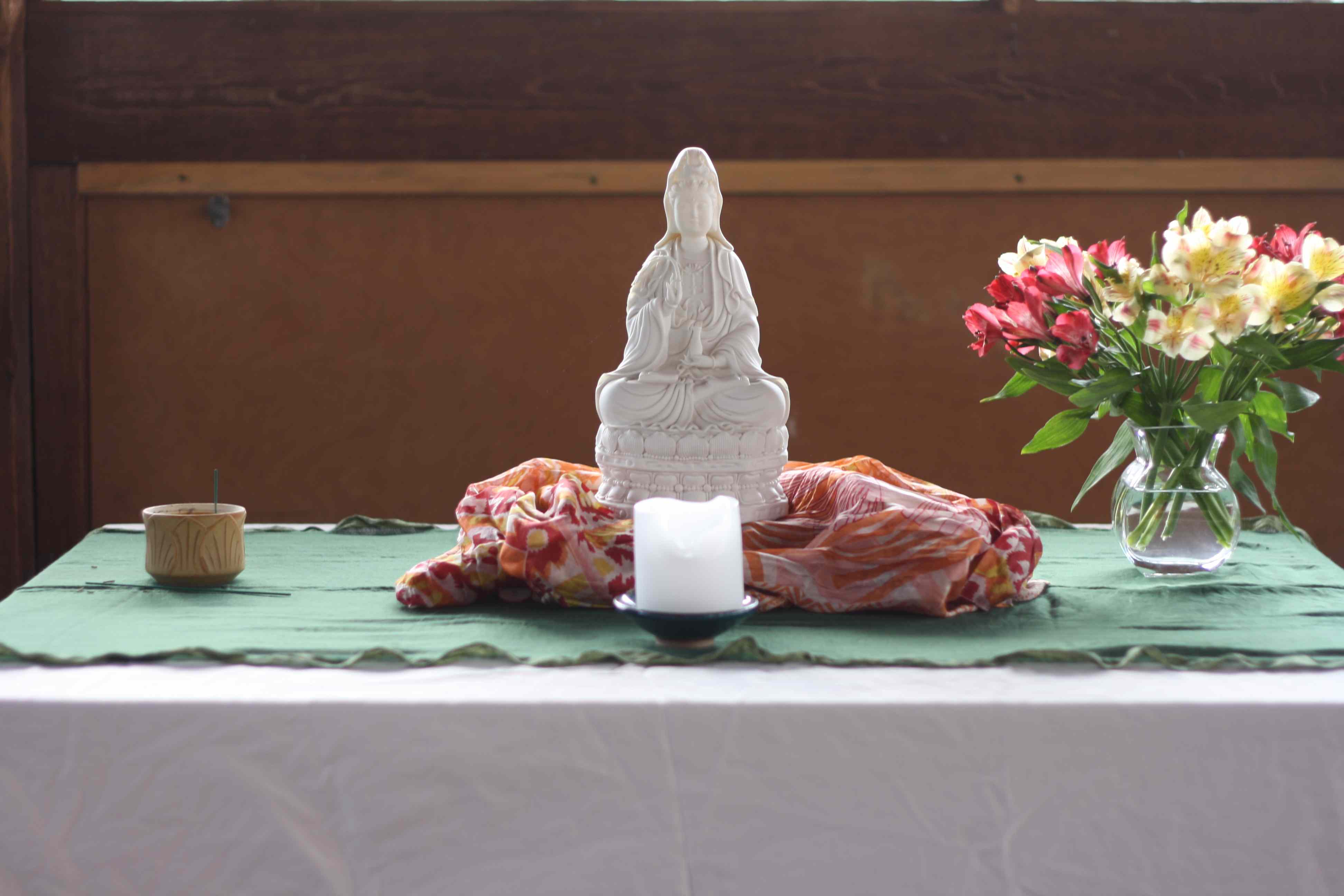
Our retreat altar. Photo by Frankie Fachilla

This  stray cat was quite friendly and had a way of slipping through the lodge door. One of our retreat attendees, Christie Bates, kindly adopted the cat, now named Khit Nhat Hanh. Photo by Frankie Fachilla

This stray cat was quite friendly and had a way of slipping through the lodge door. One of our retreat attendees, Christie Bates, kindly adopted the cat, now named Khit Nhat Hanh. Photo by Frankie Fachilla

Still some leaves hanging on. The paths and trails around Bethany Hills Camp provided some good hiking opportunities. Photo by Frankie Fachilla

Still some leaves hanging on. The paths and trails around Bethany Hills Camp provided some good hiking opportunities. Photo by Frankie Fachilla

These rocking chairs on the deck weren't used too often once the "arcitc blast" hit on Wednesday. They still looked inviting. Photo by Frankie Fachilla

These rocking chairs on the deck weren’t used too often once the “arcitc blast” hit on Wednesday. They still looked inviting. Photo by Frankie Fachilla

We closed the retreat with this offering of merit:

The Buddha said that when we dedicate merit, it is just like adding a drop of water to the ocean. Just as a drop of water added to the ocean will not dry up but will exist as long as the ocean exists, so too, if we dedicate the merit of any virtuous action, it merges with the vast ocean of merit and endures until enlightenment.  ~Padmasambhava

By the power of this compassionate practice,

May all beings have happiness and the causes of happiness

May all beings be free from sorrow and the causes of sorrow

May all live in equanimity.

Mindful Photograhy Calendar Update

Our 2015 calendars have arrived and are available for pickup at our Monday meetings or they can be shipped for $5 extra. These calendars were created by Shelley Davis-Wise and the photos were all taken at our 2014 Mindful Photography Workshop. The calendars cost $20 each, make nice holiday gifts and are a great way to support One Dharma. Here are a few sample images:

Calendar MayCalendar

calendarFebruary

To purchase your calendars, you can pay by cash, check or paypal here through our donation page. Be sure to include $5 if you prefer to have the calendars shipped. For questions, email onedharmainfo@gmail.com.

Listening to Your Thoughts Like a Friend

Meditation teachers in the West rarely emphasize thought as a primary object of meditation, even though mindfulness of mental factors is the fourth foundation of mindfulness. There’s a reason for this – from the time we’re young children, many of us are taught to revere thought above all else. When we first come to meditation we may feel as though we’re lost in the rapids of thought, tumbling down a treacherous river with no escape. Initially, establishing awareness at the breath and sensations of the body helps to calm these rapids. But not entirely. The thoughts don’t and won’t stop.

So why not learn to listen to your thoughts like you listen to a good friend? This means bringing your full awareness, with kindness, to your internal dialog. From this perspective, listening practice translates well from hearing external sounds like bird song or passing cars to awareness of the tone and quality of your thoughts, not simply the content. The practice may sound simple, but it takes skill to listen without reacting, judging or getting caught again in those rapids.

We can categorize our thoughts as positive, negative or neutral, just as we can with feelings and sensations. This can help us dis-identify with the specific content of the thought so we can simply observe. Most of us spend a lot of time problem solving, strategizing and planning. Often this activity is necessary and useful. But at other times it diverts us from our present moment experience. Listening to thought can help us to discern when we are using thought to escape and when we are using it wisely.

How often are your thoughts angry, comparing or judgmental? How frequently do you carry on internal dialog with someone who has hurt you or made you angry, but you never verbalize those thoughts skillfully or resolve the conflict? What narratives do you cling to as undisputed truths about yourself or others that narrow your possibilities? As your awareness deepens, you may notice how often your thoughts support the mistaken belief that you are a fixed, separate self, at odds with the outside world. Though listening practice, you may also become aware when compassionate and generous thoughts arise from a sense of interconnection and find opportunities to cultivate more of these. Deep concentration, Samadhi, during meditation practice helps support our insights into interconnection, which we can then bring into our daily lives.

Through listening practice I have discovered that whenever I feel a strong sense of self and other, my thoughts tend toward self-clinging or judgment. When I feel an intuitive sense of interconnection, my mind naturally opens to a more compassionate way of thinking about my life and the world. I am able to listen from the heart and respond with kindness, rather than though old thought patterns that reinforce separation.

2015 Mindful Photograhy Calendars Now Available

These calendars were created with photos from our 2014 October Contemplative Photography Retreat. Created once again this year by Shelley Davis-Wise, each photo includes a dharma quote or poem. The calendars are for sale during our regular hours and are $20 each. They are a fund raiser for One Dharma. Here is a sample image:

Calendar

To reserve your calendar(s) or arrange for pickup, email onedharmainfo@gmail.com

Women’s Beachfront Retreat Opportunity in January

This oppourtunity comes through Tammy Roth, a Nashville author, facilitator and artist:

January Beachfront Retreats at Carillon Beach, FL – these retreats are for women on a path of discovering (or recovering) their authentic selves. Each retreat will include different ways of going within to become still, quiet and tap into the most sacred parts of yourself (while having fun and enjoying yourself…yes it’s possible!) All retreats will be alcohol & substance free to avoid the traps of numbing and distracting (but still having fun and enjoying yourself) The retreats will include simple, whole foods meals, and will also rely on the powerful spirit of community to provide a sacred container as well as plenty of fun and laughter. Other aspects of the retreats will vary depending on date and co-facilitators. Pick the one just right for you! For full information, go here.

December Refuge and Precepts Ceremony

Once again this year, One Dharma will offer a Refuge and Precepts Ceremony  for committed practitioners. If you’re interested, here is some general information:

About the Refuge Ceremony
Taking refuge means relying wholeheartedly on the Three Jewels of the Buddha, Dharma and Sangha to inspire and guide us toward a constructive and beneficial direction in our lives. The real taking of refuge occurs deep in our hearts and isn’t dependent on doing or saying anything. Nevertheless, we may wish to participate in the refuge ceremony by requesting a dharma teacher to formally give us refuge. The refuge ceremony is simple: we repeat the passages after the teacher and open our hearts to make a strong connection with the Three Jewels.

About Taking Precepts
Precepts are a joy, not a burden. They aren’t designed to keep us from having a good time and to make us feel deprived. The purpose of taking precepts is to give us internal strength so that we won’t act in ways that we don’t want to. Having understood that killing, stealing, selfishness and so forth only lead us to harm ourselves and others now and in the future, we’ll want to avoid these. Taking precepts give us energy and strength to do so. Therefore, it’s said that precepts are the ornaments of the wise.

To help people overcome their disturbing attitudes and stop committing harmful actions, the Buddha set out five precepts. During the refuge ceremony, in addition to taking refuge in the Three Jewels, we can take any or all of the five precepts, and become a lay Buddhist.

The five precepts

1. I observe the precept of abstaining from the destruction of life.

2. I observe the precept of abstaining from taking that which is not given.

3. I observe the precept of abstaining from sexual misconduct.

4. I observe the precept of abstaining from falsehood.

5. I observe the precept of abstaining from intoxicants that cloud the mind and cause carelessness.

The refrain “I observe the precept of abstaining from …” which begins every precept clearly shows that these are not commandments. They are instead codes of conduct that lay Buddhists undertake out of clear understanding and conviction that they are good for both themselves and for society.

If you are interested or have questions, please contact ernst.lisa@gmail.com no later than November 17.

Fall Seeds

IMG_7428

The withered flowers

drop their seeds

like tears.

– Basho