Awareness of Breath by Ajahn Chah

Here’s a lovely and precise instruction on how to practice breath awareness by Ajahn Chah:

Just be aware at the breath. You don’t have to be aware of anything else. Keep making your awareness more and more refined until it feels very small but extremely awake.

Keep watching the breath get more and more refined until there’s no more breath. There’s just awareness, wide awake.

Let go of everything, leaving just this singular awareness.

Don’t worry about the future; don’t worry about the past.

Stay right here.

– Ajahn Chah


Awareness is Your Refuge

Especially In honor of the people who will take refuge and the five precepts this Thursday, December 20, at One Dharma Nashville, here is a lovely reflection on refuge by Ajahn Sumedho:

Awareness is Your Refuge

Awareness of the changingness of feelings,

of attitudes,  of moods,  of material change

and emotional change:

Stay with that, because it’s a refuge that is

indestructible.

It’s not something that changes.

It’s a refuge you can trust in.

This refuge is not something that you create.

It’s not a creation. It’s not an ideal.

It’s very practical and very simple, but

easily overlooked or not noticed.

When you’re mindful,

you’re beginning to notice,

it’s like this.

True Refuge Meditation Retreat Recap: Flies and Buddhas

Our True Refuge residential retreat is now complete and the retreat was truly about refuge in all of its forms. Several of us arrived early, on Wednesday evening, to practice an extra day. Thursday was overcast but mild and I had an opportunity to hike one of the trails after breakfast. The landscape in December couldn’t have been more different from the last time we were at Bethany Hills in April. From the warm and sunny days, incredible spring greens and flowers in the fields, to grey skies and barren trees, I barely recognized the place. At first the contrast was jarring. Then as I hiked the trail, I gradually settled into the stripped down winter world and felt a deep appreciation for the stillness and stark beauty. The crunch of the dead leaves on the path opened me to deep gratitude for the opportunity to spend time there on retreat.

I began the afternoon rounds of meditation settled and appreciative of the extra day’s practice. About halfway through the first sit, unexpectedly a fly landed momentarily on my lips. I recoiled and immediately brushed my lips before I realized that I was only spreading around any germs. I began thinking about what might be on my lips, worrying about whether the germs were making their way inside my mouth. Then I clearly saw my reactivity and brought my mind back to the present. I inquired, “how do I find refuge when a fly lands on my lips?” This wasn’t an intellectual inquiry, but rather one of seeking an answer from the place of insight within. Immediately my reactivity stopped and I dropped my worries about the germs. There was nothing I could do at that moment except sit. A few minutes later the fly landed squarely on my nose. I blinked just slightly in surprise, but was aware and nonreactive now, having found refuge in the way things are, even with a fly hovering by my head. It buzzed around me for about five more minutes. By now the fly had become, if not a friend, at least a guest I was willing to welcome. I do admit that after the meditation session ended, I went to my room and washed my face! I spoke of the fly during my dharma talk the next night, and discovered after the retreat that the fly had visited many people. They said they were grateful that they had an opportunity to make their peace with the fly, that it had been a good teacher in learning to cultivate non-reactivity.

Issa, a Zen poet, wrote about flies this way: “Where you find humans, there you’ll find flies and Buddhas.” This is our human condition, to continually experience the shifting movement from pleasure to pain, samsara to awakening, joy to sorrow and back again. When we are able to cultivate non-reactivity to the changing collidescope of experience, we can begin to taste true equanimity. Sometimes we are visited by Buddhas; sometimes flies. Sitting still for long stretches and walking the same ground over and over, we face our experience in every way imaginable. At times it may be painful or boring, other times joyful and transcendent. As our hearts open more deeply to this practice, we begin to appreciate all that life has to offer and we can welcome both flies and Buddhas.

One of the most welcome parts of the retreat was the amazing, ever changing weather during our practice. We had no sun during this retreat, but we enjoyed periodic rain, wind and lightning. The weather was warm enough to walk outside all weekend. Saturday evening we enjoyed a dusk meditation on the deck to a symphony of thunder and light rain. It was a magical moment of being in the midst of nature on our cushions as darkness fell, protected by the deck’s large overhang, yet still immersed in the wiles of the weather. Meditation outdoors allowed us to open our lens of attention to accommodate the wide world of nature in our practice, to take it all in with a receptive mind.

Many people found the retreat challenging, and it is designed to be. At the closing they reported finding an opening into their practice that was very rewarding and far deeper than what they had experienced during their home practice. Most discovered the joy of meeting their visitors, whether flies or Buddhas, with an open, undivided heart. Our next retreat is scheduled for April 11 – 15. You’re welcome to join us.

After the Rain
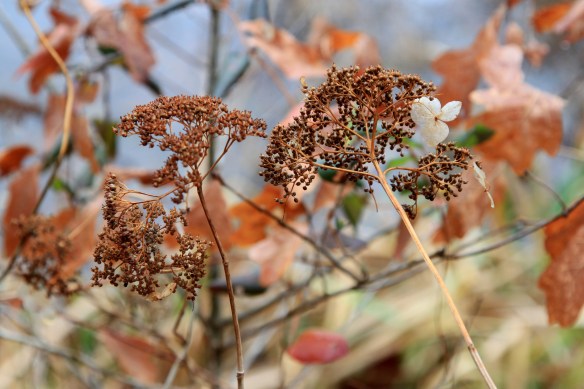
After the Rain

IMG_6113IMG_6143IMG_6145

Historic Cabin

Historic Cabin


New Year’s Half Day Retreat in Nashville

The Power of Intention: Clarifying Your Path for the New Year

January 1, 2013, 8:30 a.m. – Noon, 12 South Dharma Center

Led by Lisa Ernst

lotusblue12
“One of the Buddha’s most penetrating discoveries is that our intentions are the main factors shaping our lives and that they can be mastered as a skill.”

– Thanissaro Bhikkhu

Please join us for a half day of sitting and walking meditation at the 12 South Dharma Center. At the beginning of a New Year, it is customary to take stock of our lives, to review the previous year and set our intentions for the upcoming twelve months and beyond. Bringing this evaluation onto the cushion, to look with fresh eyes and an open heart, can help us refine and clarify our direction and to live from the truest part of ourselves.

Led by meditation teacher Lisa Ernst, the retreat will include periods of sitting and walking meditation, dharma talk and discussion. Cost is $35 and is due by Monday, December 24. You can bring your payment to one of our meetings or send a check, made out to One Dharma Nashville to: 12 South Dharma Center, c/o One Dharma Nashville, 2301 12th Avenue south, suite 202, Nashville, TN 37204. You can also pay through Paypal here. Please use the first “donate” button. For questions or to reserve your spot, email onedharmaretreat@gmail.com.

Time Enough to Wake Up

If you’re a regular meditator, chances are that you sometimes feel restless, wishing for the allotted practice time to end. If you have a clock handy you may peek once in a while.  I confess that I have done this myself occasionally when I’ve been in a very busy or challenging time in my life.  But I discovered an antidote to the restlessness that may seem counterintuitive. When I see that I’m checking the clock or longing for the meditation time to end, I extend it. I’ve learned that when I squeeze my meditation into a parameter of time, I cut it off, make it small and constrain my mind from the infinite and unfettered nature of this moment.

Sometimes I may only extend the meditation session five or ten minutes, depending on my schedule, but I’ve extended it longer on mornings when I have time. The actual length of time isn’t that important, even a few extra minutes can make a difference. As soon as I change my orientation from “hurry up” to “I’ll be here for a while,” my entire demeanor changes. I relax and let go of time. I settle into whatever I was resisting. The moment becomes interesting again, no matter how I’m feeling or what I’m thinking. The illusion of some other time or some other place vanishes. There is only this moment, perfect and complete.

Our 2013 Mindful Photography Calendars are Now Available

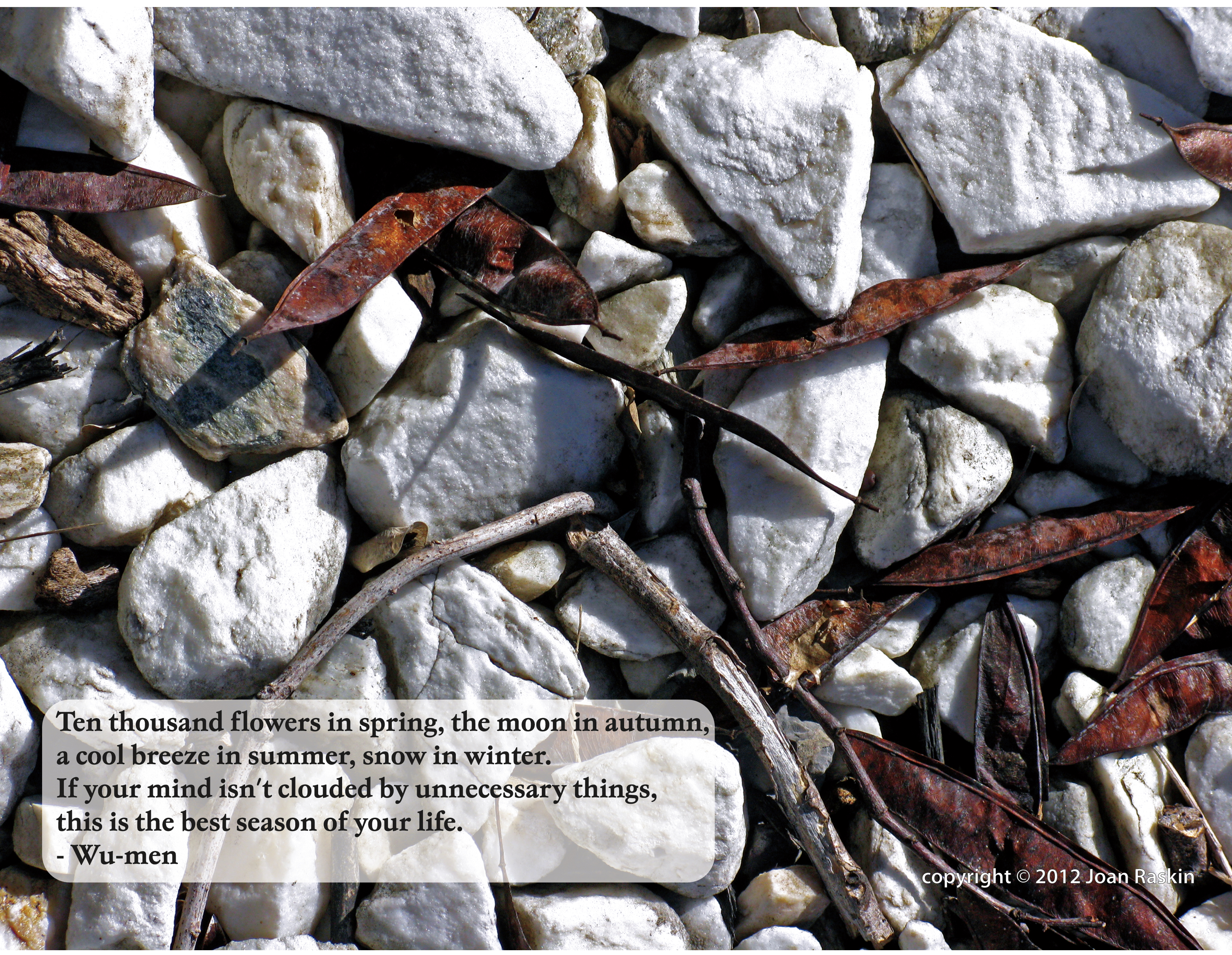
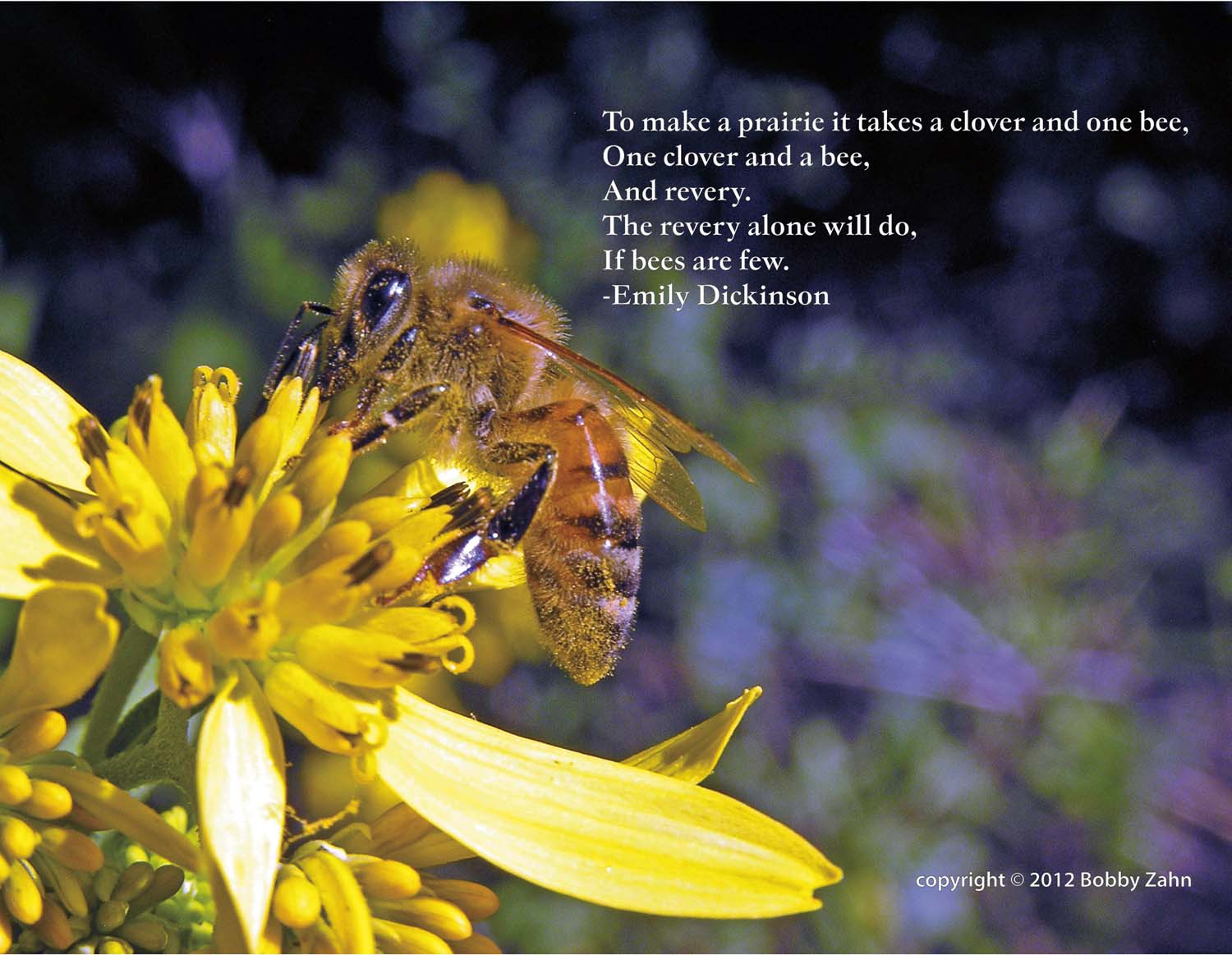
These calendars were made from photos from our 2012 September Contemplative Photography Retreat. Created by one of our participants, Shelley Davis-Wise, each photo includes a dharma quote or poem. The calendars are for sale during our regular hours and are $15 each. They are a fund raiser for One Dharma. Here are a few sample images:

For more information email onedharmaretreat@gmail.com.

Gratitude and Generosity

How giving comes from gratitude.

Sallie Jiko Tisdale

Once I was young and poor—and generous. I shared an old house with several people and slept on the porch and owned nothing more valuable than my bicycle. I volunteered many hours every week at community organizations. One day, when I had only five dollars, I treated a friend to dinner, and afterward we laughed about my now total poverty. It was easy to give away what I had; I never doubted that the world would somehow provide for me in turn.

Now I have a house and a car and a savings account, and I am not so generous. I do give—my money, my time, my attention— but sometimes I give reluctantly, with a little worry. Sometimes I want a nicer house, a newer car. I wonder if I have enough money saved. I want more time to myself. It is not just a matter of youth and age. I have many more things now, and that means I have more things to lose.

When I had little, everything I had was important. If I found a sweater I liked at the Goodwill, it felt like my birthday. In a way, having nothing meant everything in the world was mine. Even a sandwich was cause for celebration, and nothing distracted me from enjoying it. Every gift was a delight, and I was grateful for everything I had.

Gratitude, the simple and profound feeling of being thankful, is the foundation of all generosity. I am generous when I believe that right now, right here, in this form and this place, I am myself being given what I need. Generosity requires that we relinquish something, and this is impossible if we are not glad for what we have. Otherwise the giving hand closes into a fist and won’t let go.

This generosity, arising from abundance, is natural. We see it in the world around us all the time. Haya Akegarasu loved spring. “Young grasses,” he wrote, “I can’t help it—I want to kiss you.” To him the spring grasses were great teachers, because they made a “whole effort” to simply live their lives. “Their growth is a long, wide tongue that covers the whole world,” he said. I see a fearless generosity in the flowers and trees, in the way birds sing out at dawn, in the steady drumming of the rain. As I grew older and found I had things to protect, I forgot. I completely forgot that I had always had enough in the first place. Now I am trying to learn this once again—total abundance, nothing begrudged.

Sallie Jiko Tisdale is a dharma teacher at Dharma Rain Zen Center, in Portland, Oregon. Her most recent book is “Women of the Way: Discovering 2500 Years of Buddhist Wisdom.”

This item essay is from the Tricycle
Wisdom Collection

My Constant Companion

You’ve been with me

for what seems an eternity.

A shadowy presence,

keeping me up some nights

bringing an edge to my day

and nothing I do makes you go away.

Always here but you won’t show your face

until now.

This morning we met,

as if for the first time

I saw you without the veil,

not so dreadful after all.

Grateful, I welcomed you in

with an open heart.

We sat together like the best of friends

until the incense burned out

and the sun lit the  sky.

We rose as one with a smile.

Remembering

Any time a conditioned habit or emotional response gets the best of us, we’ve forgotten something important. We’ve forgotten this moment, right where we are. We’ve lost the true connection to our hearts, our breath, our bodies, the doorway into the dharma. To remember, we don’t need to get rid of the patterns or push away emotions, we just need to wake up to what’s happening in this moment. This is the starting point.

All conditioned habits feed on lack of awareness; they can only thrive when we’re not attentive and present. But how do we remember this moment when we’re swept away in the rapids of the mind? It’s a matter or practice. The more we bring our attention to this moment, how things truly are right now, the more readily we notice when we’re lost in our patterns. Even a moment of remembering can begin to undo what seemed an impossible tangle.  An open, aware heart and mind is the path and also the end of the path, the doorway into the great freedom of this moment.

December Refuge Ceremony and The Five Precepts

Last year One Dharma held a Refuge and Precepts Ceremony for dharma practitioners who wanted to formally take the vows and reflect their commitment to the Buddhist path. We will be offering this opportunity again in December. Generally, at least one year of Buddhist practice experience is recommended before taking the precepts, although there are exceptions. Here is some general information:

About the Refuge Ceremony
Taking refuge means relying wholeheartedly on the Three Jewels of the Buddha, Dharma and Sangha to inspire and guide us toward a constructive and beneficial direction in our lives. The real taking of refuge occurs deep in our hearts and isn’t dependent on doing or saying anything. Nevertheless, we may wish to participate in the refuge ceremony by requesting a dharma teacher  to formally give us refuge. The refuge ceremony is simple: we repeat the passages after the teacher and open our hearts to make a strong connection with the Three Jewels. The ceremony also “officially” makes us a Buddhist.

About Taking Precepts
Precepts are a joy, not a burden. They aren’t designed to keep us from having a good time and to make us feel deprived. The purpose of taking precepts is to give us internal strength so that we won’t act in ways that we don’t want to. Having understood that killing, stealing, selfishness and so forth only lead us to harm ourselves and others now and in the future, we’ll want to avoid these. Taking precepts give us energy and strength to do so. Therefore, it’s said that precepts are the ornaments of the wise.

To help people overcome their disturbing attitudes and stop committing harmful actions, the Buddha set out five precepts. During the refuge ceremony, in addition to taking refuge in the Three Jewels, we can take any or all of the five precepts, and become a lay Buddhist.

The five precepts

1. I observe the precept of abstaining from the destruction of life.

2. I observe the precept of abstaining from taking that which is not given.

3. I observe the precept of abstaining from sexual misconduct.

4. I observe the precept of abstaining from falsehood.

5. I observe the precept of abstaining from intoxicants that cloud the mind and cause carelessness.

The refrain “I observe the precept of abstaining from …” which begins every precept clearly shows that these are not commandments. They are, indeed, ethical codes of conduct that lay Buddhists willingly undertake out of clear understanding and conviction that they are good for both themselves and for society.

If you are interested or have questions, please contact ernst.lisa@gmail.com. For planning purposes, I’ll need to hear from you by November 8. If you’d like to see photos from last year, click on this link.