Talking Through the Trees

This is a moving essay from Sharon Safer, the director of 12 South Dharma Center. She wrote this essay as her dear friend Cynthia Schell was dying of cancer in 2006. Cyhthia’s trust provided significant seed money that allowed us to establish the 12 South Dharma Center as a dedicated Buddhist meditation space in Nashville.

Talking Through the Trees

“Are we talking through the crepe myrtles right now?” she asks.

“Yes, sweetheart, we’re talking through the trees,” I reply.

My friend is dying, and she is teaching me about talking through trees, and rainbow exercises for saying goodbye.

Lately, in every conversation, she asks, “What is in your soul today?  How is your heart?”

I tell her about my son’s seventeenth birthday; about arguments with my husband; about the Sears repairman’s fourth visit.  Of course I know that these are not answers to her questions.  It’s just that sometimes it’s really, really hard to cut to the chase and know where my soul is, or if my heart is open or closed.  So, I use the events of my daily life as the path inward.   Sometimes the path is pretty straight and short, sometimes it winds around and around, and sometimes I take a wrong turn and can’t quite get inside.

Over the years, I’ve learned that the feelings that arise from the events of my life can be a shortcut into my heart.  How do I FEEL about my son’s latest birthday?  “Oh, that’s the way inward.”  So many feelings:  pride, joy, regret, curiosity, fear.  How do I FEEL about those arguments with my husband?  “Oh, there’s another path inward: grief, fear, curiosity, anger,” or, “I don’t feel anything right now because my heart is so protected.”

But now, my friend is dying, and every day she wants to know what’s up with my heart and soul.  She won’t be around much longer.  She hasn’t the luxury of time, and I don’t want to keep her waiting.  So, I’ve returned to practices that will help clear out some of the mental debris.  I meditate daily, and write, write, write.  I want to be free from the drama of life so like my friend, I can cut to the chase and know in every moment where my heart and soul are.

There’s nothing like a dying friend who speaks through trees and about soul and heart and rainbows to bring focus to what’s truly important.  She no longer has the need to protect her heart and soul, and from this peaceful place, she speaks directly of her desire to move on; of her love for her beloveds; of the beauty of her petunias and gentle breezes.  Next summer, when she’s gone and the crepe myrtles are in full bloom, I will listen closely for her voice on the breeze, “What is in your soul today?  How is your heart?”

Sharon Safer is founder and director of 12South Dharma Center.  She has a Masters in Social Work and trained with Sanchi Reta Lawler in end-of-life contemplative practices.  For the past few years she has served the dying and gravely ill as a hospice and an oncology social worker.  In service to opening the conversation about end-of-life issues, she serves as an Advisor to The Gift Initiative (www.thegiftinitiative.org).

A Day of Mindfulness Retreat in Nashville

A Day of Mindfulness Retreat
Awakening Joy
Sunday, October 21, 9:30 a.m. – 3:30 p.m.
Led by Lisa Ernst


Please join us for a  day of sitting and walking meditation at the 12 South Dharma Center. We will cultivate insight and lovingkindness through awakening our minds and hearts to the present moment.

Led by meditation teacher Lisa Ernst, this silent retreat will focus on mindfulness meditation. We will practice bringing mindfulness to the breath and sensations in the body, cultivating awareness of the pleasant and unpleasant states that arise. Through this practice  we gradually awaken the joy of meeting all that arises with compassion and friendliness.

This retreat is suitable for both beginning and experienced meditators; it will include sitting and walking meditation, practice instructions, and a dharma talk. Please bring a sack lunch. Refreshments will be provided at the end of the retreat.

Cost: $35, plus dana (donation) to the teacher. A deposit of $35 will reserve your space and is due by Monday, October 15. You may bring your deposit to the center during one of our meditation sessions, or mail a check made out to One Dharma Nashville to: 12South Dharma Center c/o One Dharma Nashville, 2301 12th Ave. South, Suite 202, Nashville, TN 37204. Please include your email address. Directions and additional information will be emailed prior to the retreat. Please contact onedharmaretreat@gmail.com with any questions or to reserve your spot.

Save the Date — Late Fall Residential Retreat Led by Lisa Ernst

We’ll be back at Bethany Hills Retreat Center in Kingston Springs, December 6 – 9 for a residential meditation retreat. This retreat is open to anyone who would like to experience an extended period of deep dharma practice. More details coming soon.

Mindful Meditation and Photography Workshop

Contemplative Photography and Meditation Workshop

Cultivating Clarity, Receptivity and Joy With a Camera

Saturday, September 22, 8:30 a.m. – 3:30 p.m.

Led by Lisa Ernst

Led by meditation teacher and artist Lisa Ernst, the workshop is suitable to new and experienced meditators. We will awaken contemplative awareness in our photography, supported by periods of meditation and walking practice.  The wooded, private grounds at Mercy Retreat Center, in Northeast Nashville, include open fields, wooded hills and some interesting architectural elements.

Please join us for a day of mindfulness as we combine meditation and the practice of contemplative photography. There’s no need for expensive equipment or technical knowledge, just a willingness to meet the moment in an open and receptive state.  A simple, yet profound joy often arises in this alliance of mind and heart, camera and surroundings.

Led by meditation teacher and artist Lisa Ernst, the workshop is suitable to new and experienced meditators. We will awaken contemplative awareness in our photography, supported by periods of meditation and walking practice.  The wooded, private grounds at Mercy Retreat Center, in Northeast Nashville, include open fields, wooded hills and some interesting architectural elements.

The retreat cost is $75. Two sliding scale slots are available for those who need financial assistance. You have the option of bringing a sack lunch or purchasing an onsite buffet lunch for $8. The buffet is not vegetarian, but there are plenty of options if you prefer a meatless meal.

The workshop deposit without a buffet lunch is $35; with lunch its $43 (advance planning is required for the buffet meal). Deposits are due by Friday, September 14. To pay online through Paypal, go here and scroll to the bottom of the page. If paying by check, please make it out to One Dharma Nashville and send to One Dharma Nashville, c/o 12 South Dharma Center, 2301 12th Avenue South, Suite 202, Nashville, TN 37204. Be sure to include your email address. Additional details and directions will be provided in advance of the retreat. For more information or to reserve your spot, email onedharmaretreat@gmail.com

A Buddhist Monk’s Camera

Nicholas Vreeland explains to how making pictures is something he does as he proceeds through life’s pathways.

"I am a monk who makes photographs."—Nicholas Freeland

“I am a monk who makes photographs.”—Nicholas Vreeland

All of Nicholas Vreeland’s cameras were stolen in 1980. “I was sad that the person who stole the equipment would probably not know what it was. Discovering that everything was lost was like a painful sting, but not one that hurt for long. I was nearly relieved that I was free of a lot of things.” The equipment was insured, so Nicholas was able to manage things for a while with the insurance money. A few years later, his stint as a commercial photographer ended, and when he went off to become a monk, he found himself unfettered and free.

Boarding School Studios and Monasteries
Nicholas started shooting when he was 13. He studied in a boarding school in America, and says that it kept him happy there. At first, he would shoot what was around him and eventually, he created a little studio in his room to make portraits of students. He even made portraits of the Headmaster on the behest of the Headmaster’s wife. This interest spun into an occupation, and photography is what Nicholas did for a living until he became a monk in 1985. Then, he stopped shooting. In fact, it was about after ten years in Rato Dratsang, Karnataka that he revisited photography. Only recently, he displayed his work in an exhibition titled Photos for Rato, which was taken to major cities all over India by Tasveer Arts with the generous support of Zuari Cements.

A Brother’s Gift
When Nicholas moved to the monastery, his brother gifted him a camera. But Nicholas kept it locked in a trunk and rarely took it out. “I did not want it to become a part of my life.” However, after a few years, he began making pictures frequently. “I would keep the camera in my desk and photograph everyone who came into my room.”

To read the full post, go to the Better Photographer blog, here. 

My Trip to Reelfoot Lake

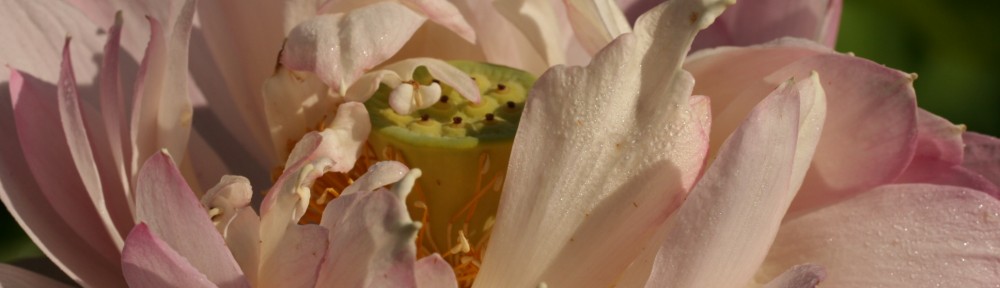
Last week I made my third trip to Reelfoot Lake to photograph the amazing lotus flowers. I blogged about it and included a number of photos at my art blog, Lisa’s Art News. To read the post and see the photos, go here.

Seeking Completion

“Humans are afraid to forget their minds, fearing to fall through the Void with nothing to stay their fall. They do not know that the Void is not really void, but the realm of the real Dharma.” -Huang Po

Recently I was taking an afternoon hike at a local state park when I came upon a hiker a few yards in front of me. Instead of trying to pass him, like I usually do, I saw a bench ahead and decided to sit down for a few minutes and simply enjoy the stillness. As I approached the bench, an image came to mind of all the benches that I pass with people sitting on them, seemingly waiting for something, occupying themselves with their smartphones or tablets. Even in nature.

I appreciate my iPhone and iPad. They serve me well and when used wisely, enhance communication and connection. But I never carry my phone on hikes, its one of the places I prefer to disconnect completely. As I sat down on the bench undistracted, I sank into the fullness of the moment, the song of the birds and the wind rustling through the leaves  emanating from my very heart, joyfully interconnected. I felt deep gratitude for the beauty of this moment, perfect and complete.

As I returned to my hike, I felt a moment of wistfulness for the dying art of just siting on a bench with nothing in hand. Humans seem to be loosing the capacity to simply enjoy the present moment, just as it is, without the need for constant stimulation. I believe that’s one reason why mindfulness meditation is becoming ever more popular. We instinctively know we are missing something essential, even as many of us grow increasingly dependent on our electronic devices and other distractions to fill the hours, to plug what appears to be empty.

Distractions aren’t new. Throughout history, humans have always found ways to divert their attention from the present moment.  Most of us recognize that our diversions aren’t simply external, but a reflection of our often restless and seeking minds. Now, however, it seems these external distractions are growing exponentially so that we never need spend a moment in stillness and silence. At some point, we need to reflect on this emptiness that calls to be filled. How often do we stop in the midst of our attempts to satiate the void, mindfully slowing down long enough to take a closer look? Could it be that the very feeling of emptiness we want to escape, when no longer resisted, is actually a source of fulfillment and joy?

Seeking completion is a key element of the human condition. From one perspective, we view our individual self as fixed and permanent, yet simultaneously we feel incomplete.  Something is missing. So we seek ways to make ourselves whole.  For most people, it’s a quest with no end. As soon as we achieve the imagined completion, such as finding a mate, career and financial success, or even spiritual achievement, the fullness dissipates and the self again seems incomplete. Our quest begins anew. The constant need for affirmation and recognition can’t really touch the deep emptiness inside; it only skims the surface with a shallow illusion of fulfillment. Even our journey on the Buddhist path will only go so far. As long as we continue to pursue completion of the self, we will feel an uneasy sense of emptiness at our core.

The way to fill the self is to release our attempts to complete it. This may sound easy, but in practice it requires a radical and courageous opening, again and again, in the midst of our myriad distractions as well as our deepest fears.  We need to come face to face with the fear that “I” don’t exist, the driving force that keeps us seeking fulfillment in every nook and cranny of our lives. In our willingness let this self go, to repeatedly face this fear, we at last have the chance for true fulfillment. When we realize that the self we are trying to complete is empty, we find completion in the joy and fullness of this moment.

– Lisa Ernst

The Good Buddhist Trap

by Lisa Ernst

“Where you stumble and fall, there you will find gold” – Joseph Campbell

Many of us in the West grew up surrounded by well meaning family, teachers and friends who stressed the importance of adhering to society-based standards of achievement and success. There’s nothing inherently wrong with challenging ourselves and working toward goals such as a college degree, a stimulating career and a rewarding family life. Unfortunately, many of us also learned to interpret any unrealized goals as character deficits, inadequate talent, lack of motivation and worse. By the time we reach adulthood, our own internal voices may have developed into the harshest critics of all.

Numerous people bring this mindset into their Buddhist practice, often unconsciously. Eastern dharma teachers have observed in western students a strong tendency toward self-criticism and low self-esteem. The tougher practice methods these teachers may use with students in their own countries are often watered down or even eliminated, replaced with a kind and grandmotherly approach intended to counteract the severe inner voices of so many students.

When we begin to study Buddha’s teachings on sila (ethics), right speech, non-harming, compassion and equanimity, most of us are inspired to cultivate these qualities in ourselves. Perhaps we wish to speak more kindly to a loved one who gets on our nerves, cultivate patience during trying times and extend compassion to those less fortunate than us. All of these intentions are worthwhile and necessary for awakening our hearts, but if we’re not careful our Buddhist intentions can become yet another inner exhortation to do better, be wiser and try harder. We may trap ourselves in a tangle of the “correct” and “incorrect” way to think and act, which suppresses what is actually arising. This repression takes us further away from sincerely manifesting our good intentions.

For example, most people on the dharma path want to cultivate genuine compassion toward the homeless.  This is a popular topic among students when I lead group discussions on lovingkindness and compassion. Many students report that they  experience aversion around the homeless rather than compassion.  They feel guilty because they are not manifesting their ideal Buddhist response. Even many long term meditators struggle with this. They forget that aversion, when met openly, is a gateway into compassion rather than something to repress or feel ashamed of.

At a deep level, I believe humans inherently know that all beings are interconnected. When another being suffers, you and I can feel their pain. Often we aren’t even conscious of this and our immediate response to a homeless person may be aversion, judgment and even intense fear. We may simply look away as quickly as possible. He or she becomes “the other” and this shields our intuition that this homeless person is actually none other than you and me. In the midst of this response, yet another layer of separation arises if we reprimand ourselves for being a bad Buddhist, short on compassion. Soon we’re so caught in our reaction to our aversion that any awareness of present-moment experience is far, far away.

But the remedy is actually close at hand. The first step is to pause long enough to  hear those critical voices; simply notice them and refrain from following their stories. Next, begin to accept and investigate the aversion, actually feel the distaste just as it is. Don’t strive to change it into compassion. As you directly experience your aversion and fear, your heart begins to open. An open and aware heart is a compassionate heart.

Begin with yourself; feel compassion for your own fear and sense of separation. As you do this, slowly your heart can open further, to embrace the suffering of other beings, including the homeless person. You may feel genuine sadness or grief for the travails of this person, the unknown circumstances that led him or her to such a vulnerable place in life. Once your heart can accommodate these feelings, compassion naturally arises, a kind and loving embrace that recognizes that all beings, high or low, good or bad, clean or dirty, are all of the same true nature and not the distant other. Sometimes your compassion may translate into action, an engaged response to suffering. At other times you may recognize there is no immediate deed that will help. Either way, you’ve discovered genuine lovingkindness, the heart of a good Buddhist.


Joan Halifax on Mindful Photography

I found this blog post this morning and thought it was quite timely considering my last post about  mindful photography. This is Roshi Joan’s  own moving journey with a camera.

Seeing Inside by Joan Halifax

When I was a kid, I got really sick. For two years, I couldn’t see. It was then I discovered I had an inner world, and it was a visual one. Since I was born with two good eyes, I knew the visual experience. Then suddenly, one morning, I felt my way down the hall of our house in Coral Gables, Florida, my hand sliding along the wall, and told my parents that I couldn’t see.

A cascade of physical disabilities followed and after a while disappeared. During the time when I was in bed, recovering from an unidentified virus, another world opened up to me. I began to re-create the outer world inside of me; I began to see inside.

When I got better, my mother and father gave me a Kodak Brownie Box Camera. Just as my interior life had appeared to me when I was sick, here was a little box that would capture what I saw. It could see inside. I was fascinated, and I was hooked. And I began to photograph the world that caught my eye, beginning from the age of six on, and now I am 70.

Today, a collection of nearly a hundred thousand photographs exists, a thread of images that span time and the world. When I was a kid, I photographed my handsome father standing proudly beside his Lincoln Continental. Soon thereafter, I photographed Cologne Cathedral with my Brownie. The haunting black and white image captured a heavy sky hanging ominously over the bombed cathedral. Recent photographs portray the faces of Tibetans, riven with the elements, Burmese elders, incandescent with innocence, and the landscapes of Zen and the Himalayas.

I never cared about or studied f/stops and shutter and film speeds. I only cared about composition and connection. I never took a class in photography, though I had friends who were great photographers, including Robert Frank, Ralph Gibson, Julio Mitchell, and others. I thought Diane Arbus was nothing but courage, and met her several times when I lived in New York. I was a huge fan. I loved the work of Ansel Adams and traveled with his daughter. Dorothea Lange’s photographs always took my breath away, as did the work of Gordon Parks and Eugene Smith. In the 70’s, I stayed in Eliot Porter’s house on occasion in Tesuque, and studied his work. More recently, the photographs of Matthieu Ricard show a view of space and light that is resonant with my Buddhist practice. Yet, though the work of other photographers interested me, I had no interest in emulating anyone. I just did my own thing, privately and joyfully, capturing light, seeing inside

As I lived with the camera, the camera was not only my eyes but also my heart. It captured and held light, light that I was always seeking and finding, light that filled the world, even the world of suffering, when light shines through the darkness.

When I was in my twenties, I discovered meditation. What a surprise! It was not so different than the gift of my childhood blindness. I could, through meditation, see inside. I could also see the world in a different way, a way the camera had taught me. The camera had given me a view, a view that accepted everything into its lens. I had a viewfinder (meditation), and a way to develop the world or action. View, meditation, action are one way that Buddhism is described. It is a summary of the Eight-fold Path of the Buddha. And it was to become my way of life, and the life I have followed and noted through my friend, teacher, and constant companion, the camera.

June 13, 2012
Prajna Mountain Forest Refuge

Be Aware of the Inner Gatekeeper

by Lisa Ernst

How many times have you encountered the inner gatekeeper in your life but didn’t let it stop you? Maybe you wanted to get an advanced degree, or change careers, eat a healthier diet or begin a committed exercise program.  The inner gatekeeper is the voice that tires to hold you back, tells you that you can’t do it. Most of us have times in our lives when we just don’t listen, move ahead with our intentions and find success.

If we’re not mindful, our inner gatekeeper can impede our dharma practice. Why? Because a key element of genuine practice is becoming aware of habitual and unconscious patterns that run our lives. Through mindfulness, we can gradually see and undo those patterns. But the inner gatekeeper wants to protect the status quo and may try to convince us that we can’t. I believe a lot of people who intend to observe a daily mediation practice, for instance, will sit more consistently if they cultivate awareness of their inner gatekeeper. In my own practice this has served me well. Some mornings, especially if I’ve slept a little later than intended and have a busy day ahead, the gatekeeper will try to convince me I don’t need to take time to meditate. I hear the voice loud and clear and admit at times I feel tempted to act on it. But I don’t – I acknowledge the gatekeeper’s voice and meditate anyway. Once I’m settled on the cushion, I’m always grateful I wasn’t deterred.

Developing mindfulness in daily life is much like building our muscles through repeated workouts. At first our attention is weak and gets swept away in habitual patterns, many of which are ingrained stress responses. Our inner gatekeeper is fully in charge at this point because our capacity to maintain presence in the face of unconscious responses is not yet developed. Our attention is overtaken by habit. The key is not to give up or get discouraged, but to remember that with each “mind workout” we make our mindfulness a little stronger. Even if you can only bring your attention fully into the present for a few seconds during a stress response, you will gradually increase your capacity. As you do you’ll become more aware of the inner gatekeeper’s voice directing you to return to your patterns. Each time you hear the voice and don’t follow it, you take a little power away from the gatekeeper. Slowly, the gatekeeper will lose its sway over you and you’ll begin to undo those old stress responses.

Uneasiness is the inner gatekeeper’s closest companion.  (If you’re unsure, take a closer look next time you hear that doubtful voice.) For this reason we are well served to meet the inner gatekeeper with compassion, even as we learn not to give in. The gatekeeper knows that releasing the anesthetizing veil of distraction and avoidance will bring us fully into this moment. With nothing to cling to, we eventually come face to face with a lifetime of evading what appears threatening: the realization that our sense of “I” as a separate, fixed self is an illusion. Even if we feel uneasy initially, however, as our practice strengthens, we can catch a glimpse beyond the illusion of safety and into the freedom of no-self. We have the chance to realize, with joy, that we are nothing, yet also everything.