Stay

Incense still lit

 sweet jasmine

invites me to stay.

My body had left

but my heart can’t stray.

Back on the cushion yet

obscured in the clouds

sadness like

 softly falling

 drops of  rain.

So steady and clear

thunder far away

stillness so deep

soon nothing  remains.

As the incense burns out

a smile lights my face.

– Lisa Ernst

Oregon Rain photography by Lisa Ernst

Oregon Rain
photography by Lisa Ernst

Partners in Crime

Yesterday afternoon I got word that a friend and long time Buddhist practitioner Rita Frizzell died of cancer. Rita and I were dharma friends, having first met as board members of the Nashville Buddhist Festival back in the early 2000’s. Rita was always ready to offer her time and talent, giving so much to establishing Buddhism in Nashville. She even designed One Dharma Nashville’s beautiful logo as a dharma gift. After many years affiliated with the Padmasambhava Buddhist Center, Rita broke away to begin her own sangha, Luminous Mind. She created a dedicated community of practitioners who met every Friday at her home. I know Rita’s sangha will deeply miss her guidance and love of the dharma.

 A couple of years ago, shortly before she was diagnosed with cancer, Rita and I met for lunch and shared notes about our sanghas, upcoming retreats and Buddhism in Nashville. As we parted, I’ll never forget the sly grin that came over her face as she said in a conspiratorial tone, “You and me, we’re partners in crime.” Thinking of that moment today brought tears to my eyes.

In Rita’s honor I decided to meditate at dusk. As I began my meditation, I reflected on her life and journey through cancer over the last 18 months. Just three weeks ago she was optimistic after getting some good news about her one of her tests, which gave hope that the cancer was diminishing. But it wasn’t to be; she had a sudden decline just two days before she died. Gone so fast, I thought as a tear trickled down my cheek. Where did she go? But the question dissolved into the sound of frogs singing and rain falling softly on the trees. Love, just like this.

Rita with her beloved rescue dog Stella

Rita with her beloved rescue dog Stella

Only the Moon

The moonlight through the trees

enters the room where I sit

and casts shadows across the floor.

It beckons me to be still,

and love just what it gives

in its fleeting time before dawn.

In this moment, still and silent

only the moon

can speak to my heart,

reveal my true nature

without even a word.

– Lisa Ernst

Penetrate Everything

What happens when you resist? Have you spent some time in your practice cultivating true intimacy with your mind and body in a state of resistance? You probably know where you hold your tension, where your body contracts and how your mind seeks diversion. But the true payoff comes when you take an even closer look. Can you become truly intimate with the tension in your body? Get to know it like a mate or a best friend? Open your heart and mind wide enough that it penetrates every cell, every infinitesimal particle of time and matter. When you can do this, you will taste complete freedom. This is where transformation occurs; in a moment of full surrender, when your resistance dies, you die.  But your great nature, your true self that embraces all and leaves nothing out, remains. What is this true nature? You can only find out for yourself. Just let your Bodhicitta, your inherent desire to wake up, guide the way.

– Lisa Ernst

Remembering

Any time a conditioned habit or emotional response gets the best of us, we’ve forgotten something important. We’ve forgotten this moment, right where we are. We’ve lost the true connection to our hearts, our breath, our bodies, the doorway into the dharma. To remember, we don’t need to get rid of the patterns or push away emotions, we just need to wake up to what’s happening in this moment. This is the starting point.

All conditioned habits feed on lack of awareness; they can only thrive when we’re not attentive and present. But how do we remember this moment when we’re swept away in the rapids of the mind? It’s a matter or practice. The more we bring our attention to this moment, how things truly are right now, the more readily we notice when we’re lost in our patterns. Even a moment of remembering can begin to undo what seemed an impossible tangle.  An open, aware heart and mind is the path and also the end of the path, the doorway into the great freedom of this moment.

Contemplative Photography and Meditation Retreat Recap

On Saturday, September 22 I led a contemplative photography and meditation workshop at Mercy Convent and Retreat Center in northeast Nashville. It was the first of its kind in Nashville that I’m aware of, although I’m sure not the last. The idea, suggested by dharma friend Lila Wheeler, seemed intriguing to me, but initially unclear in execution.  Where would we do it? Who would be interested? And how would the day progress?

The first and most significant hurdle was finding an appropriate place. After researching several options that didn’t quite work I settled on Mercy Retreat Center, a convent for retired nuns in Northeast Nashville. They’re local but rural, and rent their facilities to groups for reasonable rates. I booked it sight unseen. Finally, after a few months of only imagining the place from the few photographs available, I went to see it.

As I arrived at the center, I wasn’t too impressed. The building was generic looking other than some stained glass windows and a long, covered entrance. The grounds were pleasant but lacking in drama. I wondered if I had made a mistake. How would the plain facility and grounds translate into a day of photography? I had brought my camera and spent about ten minutes photographing outside prior to my meeting. This exercise began to ease my concerns. The grounds held enough diversity to allow for interesting shots without being so dramatic and obviously beautiful as to render any effortless, mindless shots successful. The point of contemplative photography is to pay attention, to cultivate a receptive, intimate way of seeing that allows the shots to reveal themselves. Drama and obvious beauty aren’t the point. The more mindful the photographer is, the more he or she will perceive the surroundings with a clear and fresh perspective.  At times the conditioned mind melts away into the unconstrained intimacy of camera and surroundings. Often this practice yields remarkable photos, but that’s not the goal.

Our small group of 11 (two additional people had to drop out last minute) spent nearly two and a half hours in the morning immersed in contemplative photography. The day also included several rounds of meditation. In the afternoon we went out to shoot again for about an hour. Some people reported that they were more connected with the activity in the morning, while others found the afternoon shoot (even in bright sun) to be the most fruitful.

At the end of the day I gave everyone access to a Flickr account where we could all load our photos to create a slide show.  Over the past week I have truly enjoyed seeing the images as each person added his or hers. What amazes me the most is how people see the same things so differently, or simply see different things. Each individual’s contribution is unique.

I’m offering another contemplative photography and meditation retreat next fall, at a different location: Penuel Ridge If you’d like to see a slide show of the day’s photographs, go here.

Post Script: Thanks to Shelley Davis-Wise, we created and sold a beautiful calendar based on the photographs from our workshop. The first batch sold out and we had to get a second order in to fulfill demand!


Talking Through the Trees

This is a moving essay from Sharon Safer, the director of 12 South Dharma Center. She wrote this essay as her dear friend Cynthia Schell was dying of cancer in 2006. Cyhthia’s trust provided significant seed money that allowed us to establish the 12 South Dharma Center as a dedicated Buddhist meditation space in Nashville.

Talking Through the Trees

“Are we talking through the crepe myrtles right now?” she asks.

“Yes, sweetheart, we’re talking through the trees,” I reply.

My friend is dying, and she is teaching me about talking through trees, and rainbow exercises for saying goodbye.

Lately, in every conversation, she asks, “What is in your soul today?  How is your heart?”

I tell her about my son’s seventeenth birthday; about arguments with my husband; about the Sears repairman’s fourth visit.  Of course I know that these are not answers to her questions.  It’s just that sometimes it’s really, really hard to cut to the chase and know where my soul is, or if my heart is open or closed.  So, I use the events of my daily life as the path inward.   Sometimes the path is pretty straight and short, sometimes it winds around and around, and sometimes I take a wrong turn and can’t quite get inside.

Over the years, I’ve learned that the feelings that arise from the events of my life can be a shortcut into my heart.  How do I FEEL about my son’s latest birthday?  “Oh, that’s the way inward.”  So many feelings:  pride, joy, regret, curiosity, fear.  How do I FEEL about those arguments with my husband?  “Oh, there’s another path inward: grief, fear, curiosity, anger,” or, “I don’t feel anything right now because my heart is so protected.”

But now, my friend is dying, and every day she wants to know what’s up with my heart and soul.  She won’t be around much longer.  She hasn’t the luxury of time, and I don’t want to keep her waiting.  So, I’ve returned to practices that will help clear out some of the mental debris.  I meditate daily, and write, write, write.  I want to be free from the drama of life so like my friend, I can cut to the chase and know in every moment where my heart and soul are.

There’s nothing like a dying friend who speaks through trees and about soul and heart and rainbows to bring focus to what’s truly important.  She no longer has the need to protect her heart and soul, and from this peaceful place, she speaks directly of her desire to move on; of her love for her beloveds; of the beauty of her petunias and gentle breezes.  Next summer, when she’s gone and the crepe myrtles are in full bloom, I will listen closely for her voice on the breeze, “What is in your soul today?  How is your heart?”

Sharon Safer is founder and director of 12South Dharma Center.  She has a Masters in Social Work and trained with Sanchi Reta Lawler in end-of-life contemplative practices.  For the past few years she has served the dying and gravely ill as a hospice and an oncology social worker.  In service to opening the conversation about end-of-life issues, she serves as an Advisor to The Gift Initiative (www.thegiftinitiative.org).
Be Aware of the Inner Gatekeeper

by Lisa Ernst

How many times have you encountered the inner gatekeeper in your life but didn’t let it stop you? Maybe you wanted to get an advanced degree, or change careers, eat a healthier diet or begin a committed exercise program.  The inner gatekeeper is the voice that tires to hold you back, tells you that you can’t do it. Most of us have times in our lives when we just don’t listen, move ahead with our intentions and find success.

If we’re not mindful, our inner gatekeeper can impede our dharma practice. Why? Because a key element of genuine practice is becoming aware of habitual and unconscious patterns that run our lives. Through mindfulness, we can gradually see and undo those patterns. But the inner gatekeeper wants to protect the status quo and may try to convince us that we can’t. I believe a lot of people who intend to observe a daily mediation practice, for instance, will sit more consistently if they cultivate awareness of their inner gatekeeper. In my own practice this has served me well. Some mornings, especially if I’ve slept a little later than intended and have a busy day ahead, the gatekeeper will try to convince me I don’t need to take time to meditate. I hear the voice loud and clear and admit at times I feel tempted to act on it. But I don’t – I acknowledge the gatekeeper’s voice and meditate anyway. Once I’m settled on the cushion, I’m always grateful I wasn’t deterred.

Developing mindfulness in daily life is much like building our muscles through repeated workouts. At first our attention is weak and gets swept away in habitual patterns, many of which are ingrained stress responses. Our inner gatekeeper is fully in charge at this point because our capacity to maintain presence in the face of unconscious responses is not yet developed. Our attention is overtaken by habit. The key is not to give up or get discouraged, but to remember that with each “mind workout” we make our mindfulness a little stronger. Even if you can only bring your attention fully into the present for a few seconds during a stress response, you will gradually increase your capacity. As you do you’ll become more aware of the inner gatekeeper’s voice directing you to return to your patterns. Each time you hear the voice and don’t follow it, you take a little power away from the gatekeeper. Slowly, the gatekeeper will lose its sway over you and you’ll begin to undo those old stress responses.

Uneasiness is the inner gatekeeper’s closest companion.  (If you’re unsure, take a closer look next time you hear that doubtful voice.) For this reason we are well served to meet the inner gatekeeper with compassion, even as we learn not to give in. The gatekeeper knows that releasing the anesthetizing veil of distraction and avoidance will bring us fully into this moment. With nothing to cling to, we eventually come face to face with a lifetime of evading what appears threatening: the realization that our sense of “I” as a separate, fixed self is an illusion. Even if we feel uneasy initially, however, as our practice strengthens, we can catch a glimpse beyond the illusion of safety and into the freedom of no-self. We have the chance to realize, with joy, that we are nothing, yet also everything.

Taking the Seat of Truth

Taking the Seat of Truth

by Lisa Ernst

Recently I was invited to lead an opening meditation at a regional 12 Step retreat. Everyone there was eager and interested to spend several minutes in silent meditation. As I scanned the room during the meditation, I saw the faces of nearly everyone there in quiet repose. Afterward, many people sought me out to comment on how helpful those quiet moments were before launching into the activities of the day. This experience led me to reflect on Buddhism and the 12 Step program, although I’m not necessarily comparing all of their compatibilities and differences. There are some good books available on that topic already. What I’ve been reflecting on is how the 12 Step programs are another avenue to paying attention and shedding light on those parts of ourselves we’d rather not see. What’s required at 12 Step meetings is courageous honesty. Which is, of course, what we cultivate in meditation if we’re practicing sincerely.

I starting attending 12 Step meetings several years ago and went regularly for about three years. The most familiar 12 Step program is Alcoholics Anonymous, but many other 12 Step meetings exist to support those struggling with addition and the fallout from addiction. I wasn’t personally attending to address substance abuse problems, though some would kindly argue that my chocolate addiction could bear that kind of scrutiny. But since dark chocolate has now been classified as a health food, happily, I’m not fighting that one anymore. Instead, I began attending the 12 Step program to address interpersonal issues that arose in part from growing up in a family of alcoholics. At a deeper level, I believe many of the challenges I’ve faced in my life are part of the human condition; they are things most of us grapple with, whether we have substance abuse in our families or not. At the root is the very clinging and aversion of the mind that Buddha struggled with in his quest for enlightenment. On a practical level, I found the 12 Step program assisted me in working with the lasting effects of my upbringing in an alcoholic family. This is something meditation practice alone didn’t fully address.

What I have discovered from many years of practice is that meditation alone rarely succeeds in fully opening the gates of the mind and heart, even though it is a powerful way to illuminate much of what’s been hidden within us. Buddhist meditation (on and off the cushion) is my foundational path and it has made a profound difference in my life. Along the way, however, I have utilized several adjunct paths such as psychotherapy, support groups and 12 Step programs to augment and deepen my practice. I have found that any path that encourages me to face and tell the truth about my life, and find the courage to respond in a more constructive and compassionate way, will only serve to enhance my dharma practice.

The first 12 Step meeting I chose to attend was in Franklin, Tennessee, a town about thirty minutes outside of my hometown of Nashville. The meeting’s start time meant I had to drive to Franklin during rush hour traffic. That alone was a good practice in patience for me as I’ve never welcomed long commutes. The nearly interminable waits at countless traffic lights also led me to question why I was giving up another evening during the week when I could be home doing, what? Maybe reading a magazine or watching one of my favorite chefs on the Food Network? Ok, maybe not such a good argument to stay home. I also questioned whether the meetings would be so far removed from Buddhist practice as to feel alien and incompatible. As I mulled these questions, a twinge of anxiety arose and I nearly convinced myself to turn around and go home. But my years of meditation practice allowed me to recognize the voice of anxiety without getting caught in it. So I stayed my course to Franklin and attended the meeting.

When I arrived, I was greeted by many welcoming and friendly faces and I immediately felt at home. During the first meeting I kept quiet and just observed, but I appreciated the honesty and courage of the people in the room. They were clearly committed to telling the truth about their lives and exposing the hidden parts of themselves that led to suffering and even destructive behavior. Everyone who speaks at a 12 Step meeting must share directly from their own experience rather than from a conceptual understanding of their suffering. This direct and honest sharing is nearly always met with empathy and acceptance by the others in the room. There is no room for judgment. This allows an atmosphere of honesty to flourish. Twelve Step groups also cultivate a sense of community and compassionate support, much like a Buddhist sangha. Moments of meditation are often included in 12 Step Meetings, although most of the time is spent in group sharing.

Over the course of several meetings, I found myself responding to the emphasis on personal experience and honesty in a way that helped me with my own struggles. The approach felt quite compatible with my own Buddhist practices. Soon the meetings became a regular part of my week and I even made several new friends. Most evenings just as I took a seat at the meeting, a moment of awakening would occur: my mind would become clear and I would see something within my own heart that had been obscured. Often from these insights I would discover ways to begin undoing old patterns that had kept me locked in suffering. Sounds much like dharma practice, doesn’t it?

The word “dharma” actually has dual meanings. In the Buddhist tradition it has come to signify the Buddha’s teachings, while also pointing to “the truth of this moment.” For me, attending 12 Step meetings created a new avenue to work with difficult emotions and old patterns within the context of my dharma path. Although not a substitute for meditation, the meetings provided another way to experience the truth of this moment.

After attending 12 Step meetings for several years I found that I was less bound by the effects of my upbringing in an alcoholic family. I had become more at ease with others and the old stories of pain and despair that swirled in my mind had diminished to a whisper. I realized the meetings had served their purpose and it was time to move on with gratitude and appreciation.

The Lotus Blooms in the Mud

by Lisa Ernst

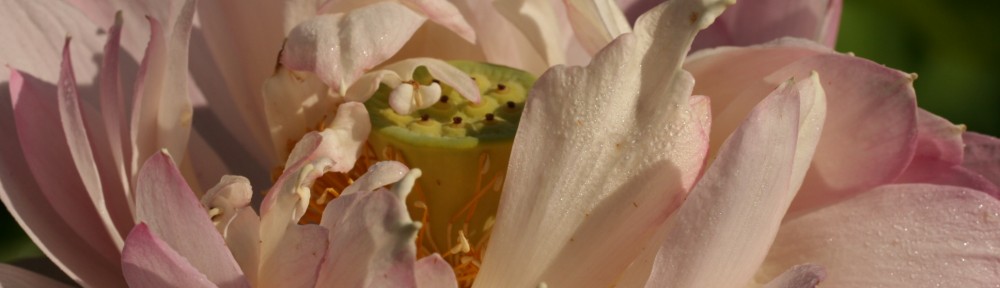
The lotus flower is revered in Buddhist lore because of the way it grows and blooms. Lotus plants thrive in muck and mud, yet they produce some of nature’s most glorious flowers. The Buddha taught that the muddy, murky condition of the mind is the very place where our own Buddha nature thrives. We don’t need to eliminate this imperfection to awaken to our true nature.

Recently I became aware of a specific situation in which this teaching manifests clearly in my own life. I live within walking distance of Radnor Lake, a beautiful state park that is pristine and peaceful when it’s not packed with people. Because its so close, I exercise on the trails at Radnor several times a week. Often in the rainy season the hiking is muddy and the crowds are a bit smaller; no doubt many want to avoid stepping in the muck and getting their shoes dirty. This doesn’t prevent me from hiking as I know its part of the experience, but I still find myself trying to avoid the muddiest parts.

Usually I arrive sometime in the afternoon, hoping to beat the after work crowds. I’ll hit the trail at a brisk pace, with little intent of communing with nature, often mentally engaged in whatever is going on for me that day. My mind is often moving as fast as my body. I’ve done this for so many years now that I’ve ingrained a pattern of launching my hikes nearly oblivious to the beautiful sites around me and the joys of nature. Yet, seemingly in spite of this, Radnor Lake is where I have many of my deepest “off cushion” insights.

Some people who are hiking alone at Radnor talk on their cell phones or listen to their iPods, apparently uninterested in enjoying the simple sounds of nature. Others may come here with the express desire to walk mindfully along the trails. This can be a nice practice in and of itself, but it may only offer a brief respite from our often overactive minds. For me, without life’s usual external distractions, the intensity of my thoughts and feelings becomes more apparent to me as I hike. I’m often immersed in the muck, regardless of whether the trails are muddy or dry. Yet this immersion in my human imperfection provides the ideal opportunity for me to access my wisdom.

If we hold on to an idea that only peaceful mindfulness is appropriate at a place like Radnor Lake, we block our chance to truly enter our own great nature. Ideals like this can be used to resist what’s truly present. When I first began to notice how unsettled my mind was during my hikes, I tried various means to fix it. I brought mala beads to Radnor and I tried to practice metta along the trails. Although I didn’t realize it at the time, my intention with these practices was incorrect: I was seeking a way to shut down my discomfort rather than to use the practices as skillful means to open heart and mind. Needless to say, they didn’t work and I abandoned the effort. One benefit of practicing sincerely over time is that we begin to discern more quickly whether we are using a particular practice skillfully or to resist and repress what’s really present.

It takes courage to face ourselves just as we are, to let go of a spiritual ideal and to reside in the midst of our own human imperfections with no distractions. Now when I hike at Radnor, I recognize that the path to clarity and equanimity is right in the midst of my own unsettled mind. When I am willing to pause long enough to genuinely touch the tenderness, the anxiety or fear that often accompanies a mind full of thought, the sounds and sights of nature become vividly alive. This softening and presence of heart may bring a tear or a smile, but the spinning of my mind simply stops in the midst of this moment. At this juncture, each step along the way, whether the trail is dusty and dry or squishy with mud, happens with effortless presence and gratitude. Whatever I was struggling with clears and is no longer a problem to be solved. The lotus indeed blooms in the mud.