Practicing With Boredom

This was my first dharma essay, which I wrote about four years ago.

Practicing With Boredom
by Lisa Ernst

Often in dharma writings and talks, emotions and mind states such as fear, despair, craving and aversion are given plenty of attention. But how often do you hear about boredom? Although it’s mentioned less frequently, boredom can be a deceptive mind state that easily leads us away from an opportunity to awaken to this moment. I feel inspired to write about this mind state because recently I had an experience that reminded me of how deceptive “boredom” can be and how it can also be a gate into liberation.

One morning recently I hit a creative block in my painting. It had been a long time coming, but it finally came to a head, and I abruptly put down my brush and ended my painting session. Distressed, but not in a mood to face it fully, I headed to the kitchen and made a batch of brownies. Everyone who knows me is aware of my deep love of anything chocolate. But I hadn’t had an unplanned brownie bake like that in a long time. I must say that the brownies were quite good, and I decided to take a long hike at Radnor Lake to atone for the indulgence.

As I got onto the trail I noticed how strongly my mind was caught in the drama of my creative block, separating me completely from my experience of hiking in the woods. This awareness in itself helped me to become a little more present. Yet I encountered an unexpected feeling — boredom; my mental drama seemed more interesting than simply walking quietly along the trail. For a brief moment I was tempted to avert my attention away from the boredom and back to the spinning thoughts. But instead I decided to investigate the boredom.

I have practiced with boredom at long meditation retreats, when the hours and the sitting seemed interminable. Unexamined feelings of boredom can lead to what the Buddha called “sloth and torpor” where our minds become dull and completely inattentive. Is it truly a mind state that is stale and uninteresting, the very essence of something we should ignore or try to change, or is it something more? Often, boredom is a kind of aversion to whatever is happening in this moment, leading us to believe that we need to divert or occupy ourselves with “something else” rather than our present experience.

As I looked into this question as I hiked, paying attention to and experiencing my boredom, my aversion to being present simply vanished. Suddenly any desire to cling to my drama, any feelings of separateness from the moment were gone, replaced by the sounds of the birds singing, the soft ground beneath my feet and a gentle breeze against my skin. There was no longer an “I” apart from the experience of hiking through the woods. The act of paying attention to the boredom, of letting it in, was also the act of letting go into the moment. As one of my favorite dharma teachers, Stephen Levine says, “Letting in is letting go.” With a calmer, less reactive mind, I also gained a few insights into my creative block.

Living the Questions

“Be patient toward all that is unsolved in your heart and try to love the questions themselves. Do not now seek the answers, which cannot be given you because you would not be able to live them. And the point is to live everything. Live the questions.” – Rainer Maria Rilke

This poem is striking to me in its simplicity and truth. For many of us, it’s so easy to tangle up our energy in trying to solve questions that need to be lived instead. I had been formulating an idea for a New Year’s (January) retreat when I saw this poem and realized it was a perfect fit for the day’s focus.The retreat will be a silent mindfulness meditation retreat, but there will be instructions on how to work with unresolved questions in the midst of the  practice. The approach can open us up to a much deeper clarity and wisdom than we can achieve trying to resolve our questions by figuring them out.

The retreat is scheduled for Saturday, January 28 at the 12 South Dharma Center. For retreat details, go here.

How Sticky Are You?

By Lisa Ernst

When I was in my late teens and early 20′s I suffered from agoraphobia, which literally translates into “fear of the marketplace.” This is an apt description; I had arranged my life so that I would have no need to interact with humans in any way, shape or form, except for one thing – I had to go to the grocery store. Encountering grocery store clerks at the check out line was usually very painful for me as I was convinced they were judging me, laughing at me and talking about me after I left. These encounters would linger or “stick” to me for days as I replayed them again and again, ingraining more deeply my own misguided perceptions of how the world saw me.

Obviously I had emotional and psychological issues that I needed to address, but most of us experience some version of this on a regular basis – encounters with others that stick to us long after they’re over. If we’re not mindful of what we’re doing, we end up trading our equanimity for replaying these situations again and again, until they become fixed in our minds as reality. There is an enduringly popular Zen parable that points to this kind of “stickiness”:

Two traveling monks reached a river where they met a beautiful woman. Wary of the current, she asked if they could carry her across. One of the monks hesitated, but the other quickly picked her up onto his shoulders, transported her across the water, and put her down on the other bank. She thanked him and departed.

As the monks continued on their way, the one was brooding and preoccupied. Unable to hold his silence, he spoke out. “Brother, our spiritual training teaches us to avoid any contact with women, but you picked that one up on your shoulders and carried her!”

“Brother,” the second monk replied, “I set her down on the other side, while you are still carrying her.”

Meditation and mindfulness practice offer us a great opportunity to assess how often human encounters “stick” to us after the actual moment of interaction has passed. Through committed practice, we can awaken to the amount of time we invest in rehashing past events while deepening grievances and other emotions at the expense of living in the present moment.

I began reflecting on this one day when I received an upsetting rejection letter from a gallery owner in New York. Two weeks earlier she had emailed me personally, saying she had found my website, was impressed with the quality of my art, and she invited me to submit my portfolio for an upcoming show. I was busy working on a commission at the time but I squeezed in several hours to prepare and send a portfolio. I enjoy visiting New York City so I was excited about the opportunity.

Two weeks later, I received a boilerplate rejection letter without even the gallery owner’s signature, saying “your work is not the right fit for our gallery.” I was insulted at the impersonal nature of this letter considering her initial solicitation, not to mention the time I invested in preparing a nice portfolio for her. It felt like a slap in the face.

Later that day I was running some errands when I realized that I was barely noticing my activities. I was lost in frustration at this woman. She was “sticking” to me and weighing me down as I carried her with me through my day. This moment of waking up, of seeing into my mind pattern, led me to look more closely and inquire into my heart as to what kept me holding on to her. This wasn’t an intellectual question, an attempt to figure it out mentally. The question was aimed at my present moment experience of entanglement. I could clearly see that I had been trapped in my outwardly directed grievance, attached to the idea that she should have responded differently. This insight enabled me to let the attachment go and open fully to my immediate experience, to feel my disappointment, to let it be “just like this.” My mind and heart softened into the present moment. As the knot of disappointment untangled, it was clear that no further thought or response was necessary, so I put her down and continued with my day.

Meditation is Not a Hobby

Meditation is not a hobby. It is important to address the problems of the world, of our society, to express our understanding through compassionate action. But if the world is truly to be a place of peace then we need to understand our own minds. Because what is happening “out there” is simply a manifestation of what is happening in the mind.

-Joseph Goldstein

Meditation and the Release Valve

Meditation can be like loosening a valve to release pressure. Sometimes emotions, strong thoughts, and anxiety can build up and create pressure inside. Coming into direct contact with these elements through meditation and mindfulness practice can act as a release valve that lets out pressure. Afterward, we often experience a feeling of lightness and ease.

Coming into direct contact with experience means there’s no filter or barrier (resistance) keeping you separate from what is arising in this moment.

Seeing This Moment Just as it Is

by Lisa Ernst

A samurai once asked Zen Master Hakuin where he would go after he died.
Hakuin answered ‘How am I supposed to know?’
‘How do you not know? You’re a Zen master!’ exclaimed the samurai.
‘Yes, but not a dead one,’ Hakuin answered.

Recently a friend posted on Facebook that he felt sad because it was the anniversary of his mother’s death, along with a dear friend and mentor of his. Quickly the comments came pouring in. The responses were well intended, no doubt, yet nearly all of them contained a type of story designed to make the grieving individual get past his sadness.  Here’s a sample of the comments: “Just remember that your mother is in a better place now.” “Your mother is watching over you from heaven.” The next comment came from the original poster, saying “I’m sad my mother won’t be here to see my daughter grow up.” The comments that followed again were designed to smooth it over “She watches your daughter every day.” “She’s guiding your daughter even though you don’t see it.” Again, the original poster commented saying, “Thanks for your comments, but I’m just really in a funk right now.” Finally the tone of the replies changed. The last few posts were without stories or attempts to smooth over his grief. Instead they just said “I’m sorry for your loss,” and “That must be hard for you.” Comments like these indicated that the commenters actually heard his grief and didn’t feel the need to dissuade him from his experience. His final post reflected that this “caring without fixing” really was meaningful to him.

In my experience, even long term meditators will fall into the pattern of trying to smooth over and create stories when people share a significant loss or feelings of grief. Many of us are inexorably drawn to imagine favorable outcomes to make ourselves and others feel more positively about bad news and loss, often in hopes of not getting stuck in negativity. The truth is that many grieving people are caught in a trap of negative stories, telling themselves that they will never recover, feel happy or find meaning in life again. So it’s understandable that those around them want the grievers to “look on the bright side.” The problem is, it doesn’t work and often makes things worse.

I experienced this myself in 2008 when an art show in Houston I had been preparing for many months was abruptly cancelled because of Hurricane Ike. I had been showing at a wonderful museum district Houston gallery for years, and finally I would see it in person and meet the owner and staff members. In addition, many friends from Texas were planning to come to the show. On the Thursday before the show, I got word that Ike was scheduled to hit the city on Saturday. My initial thought was that the show would be rescheduled a week or two later. That thought made me feel a little better. But once the storm passed through, it was obvious that repairing the city infrastructure would take much longer than expected. The show could not be rescheduled, and I was very disappointed. As I shared this with people I knew, I kept hearing their stories and attempts to put a positive spin on it, such as “I’m sure the gallery will reschedule in a few months,” and “this is proof that the universe has bigger plans for your art.”

I was tempted to believe those stories, to try and latch onto a positive scenario that would take the edge off my disappointment and justify all the work I had done.  I also struggled with the tendency to speculate that I had some kind of “bad karma” that had brought on the unfortunate timing of the hurricane. In the first few days after the cancellation, my mind regularly moved across the continuum from positive pep talk to thoughts of despair. But the benefit of my meditation practice allowed me to see this pattern quickly enough that I didn’t dwell there for long.  Gradually I began to see through the reactive thoughts to my genuine response:  loneliness. Initially this made no sense to me and I tried to overlook it. Slowly, though, I quit turning from the loneliness or seeking an explanation. As I experienced the loneliness fully, the duality of my positive and negative thinking ceased and the wisdom of my true response became clear. Like most artists, I create my work in solitude, and the art show is a celebration of that effort in community. Because of the hurricane, the culmination of my effort — the public celebration — was never realized.  Hence the loneliness.  Nothing more and nothing less. Acknowledging and experiencing this loneliness allowed me, with lovingkindness, to let go and move on from disappointment.

Wisdom and insight arise when we cease to interfere with what is actually present in our experience at each moment. When circumstances occur that don’t fit our ideas about how things should be, our stories can be quite subtle, to the point that we may perceive them as “truths” rather than concepts and ideas. As long as they’re obscured from our consciousness, there’s no way we can let them go. We may do well to regularly ask ourselves, “what is true in my experience right now? What is the content of my mind and heart in this moment?”  Seeing the present, just as it is, creates the ground from which wisdom will reveal itself.

The Zen story at the beginning of this essay points to the mind that seeks answers that are often removed  from our present moment experience. Hakuin, in his wisdom, didn’t try to answer the question of his death with speculation or theory.  He simply acknowledged the obvious and let it go at that.

The Lotus Blooms in the Mud

by Lisa Ernst

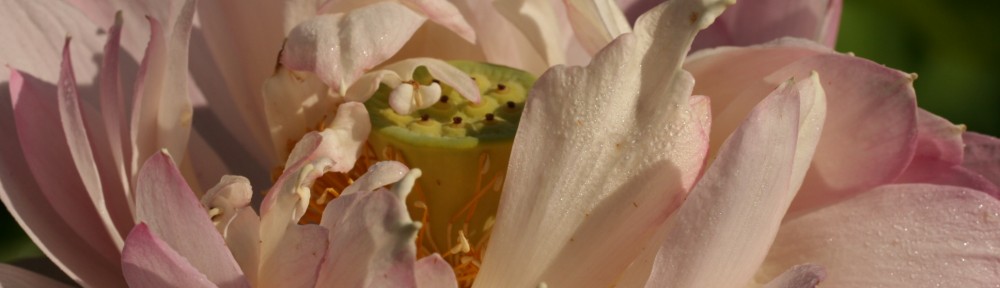
The lotus flower is revered in Buddhist lore because of the way it grows and blooms. Lotus plants thrive in muck and mud, yet they produce some of nature’s most glorious flowers. The Buddha taught that the muddy, murky condition of the mind is the very place where our own Buddha nature thrives. We don’t need to eliminate this imperfection to awaken to our true nature.

Recently I became aware of a specific situation in which this teaching manifests clearly in my own life. I live within walking distance of Radnor Lake, a beautiful state park that is pristine and peaceful when it’s not packed with people. Because its so close, I exercise on the trails at Radnor several times a week. Often in the rainy season the hiking is muddy and the crowds are a bit smaller; no doubt many want to avoid stepping in the muck and getting their shoes dirty. This doesn’t prevent me from hiking as I know its part of the experience, but I still find myself trying to avoid the muddiest parts.

Usually I arrive sometime in the afternoon, hoping to beat the after work crowds. I’ll hit the trail at a brisk pace, with little intent of communing with nature, often mentally engaged in whatever is going on for me that day. My mind is often moving as fast as my body. I’ve done this for so many years now that I’ve ingrained a pattern of launching my hikes nearly oblivious to the beautiful sites around me and the joys of nature. Yet, seemingly in spite of this, Radnor Lake is where I have many of my deepest “off cushion” insights.

Some people who are hiking alone at Radnor talk on their cell phones or listen to their iPods, apparently uninterested in enjoying the simple sounds of nature. Others may come here with the express desire to walk mindfully along the trails. This can be a nice practice in and of itself, but it may only offer a brief respite from our often overactive minds. For me, without life’s usual external distractions, the intensity of my thoughts and feelings becomes more apparent to me as I hike. I’m often immersed in the muck, regardless of whether the trails are muddy or dry. Yet this immersion in my human imperfection provides the ideal opportunity for me to access my wisdom.

If we hold on to an idea that only peaceful mindfulness is appropriate at a place like Radnor Lake, we block our chance to truly enter our own great nature. Ideals like this can be used to resist what’s truly present. When I first began to notice how unsettled my mind was during my hikes, I tried various means to fix it. I brought mala beads to Radnor and I tried to practice metta along the trails. Although I didn’t realize it at the time, my intention with these practices was incorrect: I was seeking a way to shut down my discomfort rather than to use the practices as skillful means to open heart and mind. Needless to say, they didn’t work and I abandoned the effort. One benefit of practicing sincerely over time is that we begin to discern more quickly whether we are using a particular practice skillfully or to resist and repress what’s really present.

It takes courage to face ourselves just as we are, to let go of a spiritual ideal and to reside in the midst of our own human imperfections with no distractions. Now when I hike at Radnor, I recognize that the path to clarity and equanimity is right in the midst of my own unsettled mind. When I am willing to pause long enough to genuinely touch the tenderness, the anxiety or fear that often accompanies a mind full of thought, the sounds and sights of nature become vividly alive. This softening and presence of heart may bring a tear or a smile, but the spinning of my mind simply stops in the midst of this moment. At this juncture, each step along the way, whether the trail is dusty and dry or squishy with mud, happens with effortless presence and gratitude. Whatever I was struggling with clears and is no longer a problem to be solved. The lotus indeed blooms in the mud.