Practice Idea – Taste The Mud and Be Free

IMG_6809In Buddhism we often talk about remaining fully present and mindful in the midst of unpleasant sensations, thoughts and emotions. Most people understand this, but actually sustaining presence beyond noting and momentary awareness is often quite challenging.
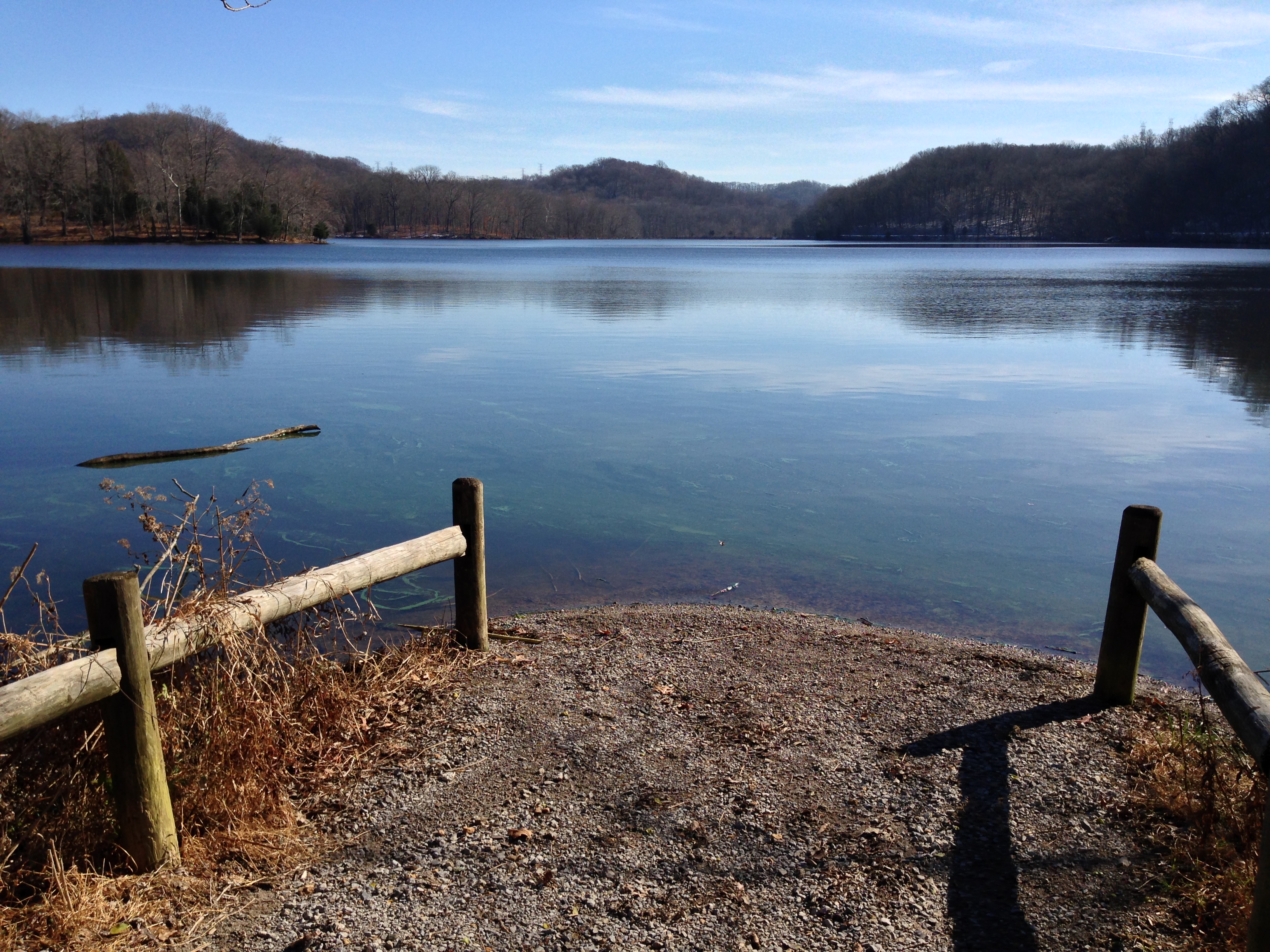
When we’re in the midst of difficult feelings or sensations, we may transition from avoidance into full presence for short bursts of time. That’s an important step. But with especially intense discomfort, it’s all too easy to quickly re-engage with external stimuli and old stories to blunt the intensity. Somehow it feels safer than stepping over the edge and letting go, where it seems the discomfort may swallow us.

I’ve found a practice approach that helps me sustain attention when I need a little extra encouragement. I look for simple, even playful ways to increase my capacity to stay present long enough to counter my ingrained resistance. What I’m doing is interrupting the flow of mental formation long enough to create a gap.

I discovered this practice at a time when I was so upset and miserable that the last thing I wanted was to increase my discomfort by feeling it more fully. This very resistance was a clue – time to face it, not run away. But my mind was like a wild horse, rearing and bucking, ready to run. To redirect the energy I asked myself what this horrible sensation tasted like. As someone who especially enjoys food, this question stimulated my interest and interrupted an entrenched reactive pattern. My resistance went down a notch; my mind stilled a bit. If you are more auditory or tactual, look for a specific sound or touch instead.

The key here is that you are engaging in direct experience, what’s actually present, no analysis or stories added. Just find a visceral taste, touch or sound. The answer to my own question was mud and manure – that’s what the discomfort tasted like. Really unappetizing and not even food! This lightened me up a little and engaged my curiosity. After the first few moments of really tasting mud in all its dark grit, the present wasn’t overwhelming anymore. I could stay with it. As I let go, the last slivers of separation and resistance dissolved into immediate experience. The mud dissipated on its own.


Instructions on Working with Questions in Your Practice and A Guided Meditation

“Be patient toward all that is unsolved in your heart and try to love the questions themselves. Do not now seek the answers, which cannot be given you because you would not be able to live them. And the point is to live everything. Live the questions.” – Rainer Maria Rilke

Unanswered questions, intractable situations often appear to stand in the way of living from our deepest intentions. At times we might feel blocked even from knowing what our true priorities are. But if we take time to turn inward with a spirit of patience and inquiry, instead of requiring the dilemmas to go away, or insisting on immediate resolutions, we can discover the resources we need. Internal dilemmas contain a rich source of insight; learning to live with them brings about a radical shift that opens the door to clarity and equanimity.

Working with unresolved questions in your meditation practice is an intentional focus, like metta, which is different from basic breath and body awareness. We are directing our attention to something more specific, in this case, deep questions in our lives. We are creating an intention to bring the question into our hearts with a quality of openness and interest, but not with an intent to analyze or resolve.

Your question may be about some aspect of your life that doesn’t make sense: loneliness, career or finances, a difficult relationship, perhaps old conditioning that keeps reappearing unexpectedly no matter what you do. It may be about health or chronic pain, the loss of a loved one or maybe deep spiritual question about life and death. Most of us are intimately familiar with our themes, the questions that we just can’t resolve.

In exploring your questions this way, they can transform into a life force. Living your deepest questions is living your life fully; loving your questions is loving even those parts of your life and those parts of yourself that you may have shut out.

This is where the radical shift can occur. Often unresolved questions represent parts of our lives that we resist. Trying to figure them out and resolve them takes us away from this moment, where the question can come alive. This is the portal to wisdom and insight. It only opens when we can move out of the realm of the intellect and our normal attempts to solve the question. Living our questions brings us fully into this moment.

Guided Meditation

Give yourself about 20 – 30 minutes to do this practice fully.

Find a comfortable place to sit. Take a few deep breaths and settle into this moment. Now take a few minutes to find your question and bring it into your heart

As you find it, just open up to it as a living thing

Keep sitting with whatever arises and let go of any thinking or stories until you become aware of your body

Notice what you feel

As the question settles into your body you may feel sadness or grief, despair, anger, fear, love or compassion. Don’t attach to the name or the explanation. Just feel it. You may even feel neutral. If it’s neutral or blank, just be with the experience of that. Chances are it will change of its own accord as you stay present. It may also appear as energy. This can happen when we move the question out of the realm of thought and into our hearts.

If you feel overwhelmed and quickly engage in busy or intensive thought, the question may be too charged. Pull back and focus on the breath or another object of attention until you feel more settled. Then return to your question as you feel ready.

There is a lot of life and energy in our deep questions once we open our hearts and minds to them.

Once your question settles into your being, just let it rest there and don’t try to direct or see the outcome. This is where your mindfulness practice will serve you, in this spaciousness of mind and heart that we can’t always so easily access in our day to day activities.

If you feel something arising allow it to flow and move. Sadness grief, energy, even joy, whatever it might be, just be open to it welcome it and let it be in your heart. If you need to cry that is ok too.

What we’re learning to do is hold the question in the realm of not knowing, the realm of mystery. With patience, we let go of trying to resolve anything. Slowly, we learn to respond from an unbiased heart, our inherent wisdom.

You can listen to my dharma talk on working with questions here.

For my Buddhist Geeks podcast on working with questions, click here.

Guest Blog from Saturday’s Writing and Meditation Workshop

February is always a little tricky for scheduling events — there’s always the chance, no matter how slight, of snow. Last year I awoke to snow on the day my writing and meditation workshop was scheduled and I deliberated for a couple of hours whether to cancel it. Ultimately I went forward as the temperatures warmed up  just in time to melt the snow. This Friday on the eve of my workshop, the Weather Channel predicted an 80% chance of snow with a 1″ accumulation for Saturday morning. I went to bed unsure whether the workshop would happen.  Thankfully, though, the snow passed us by again here in Nashville. We may be one of only a few southern cities to have avoided snow this year – so far.

During the workshop everyone had a chance to read their writing in small, intimate groups or at the end of the day, to everyone there. Andrea Hewitt read a beautiful and inspiring essay she wrote that morning and I want to share it with you here:

When It’s Time to Fly

Andrea Hewitt

What touched me today was reading about the actress Ellen Page’s coming out and particularly watching the video on the Human Rights Campaign website. Here was this accomplished young actress speaking in front of a crowd–something I’m sure she has done many times before. You could hear the nervousness in her voice–the wavering and uncertainty.

But what I was most transfixed by were her hands. They were shaking so much that she had to hold them cupped together for almost the entire time. At one point, she let them go to make a point, and they were like tiny birds released, but still unsure of how high to fly.

About halfway through her speech when she finally said the words, “I’m gay,” and the audience stood and cheered for her, I thought, “Wouldn’t it be marvelous if everyone upon coming out had a cheering audience swelling with whoops of joy, mirroring back to you the terrifyingly awesome feeling of finally releasing your authentic self out of your mouth and into the world?”

It’s like watching a birth: the long wait and gestation before, the agonizing pains of labor, but then the deep knowing that there is no going backwards–in fact, what’s back no longer exists even–and you are propelled into a shiny, brand new, sparkling world that blinds you with its rightness. And you wonder how you ever lived in the dull past with you old, small, tightly-reined-in self.

Letting it all go–the expectations, the dreams of someone else for you, your own dreams that never quite fit no matter how you cut and sewed and re-sewed them–it’s the scariest thing ever. It’s tough enough to do that for yourself and your family & close friends privately, let alone on a widely-broadcast YouTube video.

But to live every day as authentically as you can–what a gift to yourself and the world! I could see the relief on her face when the words came out of her mouth. Naming ourselves, saying the words, and believing that you can say them and there will be a bridge to carry you to the other side requires such a leap of faith.

I remember testing out the words myself before I dared to speak them aloud to anyone. It felt like I had a tiny baby bird inside me–me, its nest–and it was time to push her out. Keeping her in the once-safe nest was no longer an option for that would only stunt her growth. I had to have faith that her wings were ready and strong enough to take on the world.  It was her time to fly.

Please go by and visit Andrea’s new blog: A Late Life Lesbian Story

Freedom and The Demons

White Heron in Open Sky photography by Lisa Ernst

White Egret in Open Sky
photography by Lisa Ernst

I often encourage practitioners who are struggling, tied up in knots and feel stuck with nowhere to run, to surrender and put their heads in the mouth of the demon. Its one of my favorite teaching metaphors because its so vivid and unambiguous. From some this image draws stunned silence or a wince; from a few others a slight smile and a nod. Even though many practitioners reach an intellectual understanding, I’ve found that only a few fully experience the liberation that comes from an intimate view inside the demon’s mouth

This metaphor arises from an anecdote about the Tibetan yogi Milarepa.  Here’s the story from Tara Brach in her book, Radical Acceptance:

The great Tibetan yogi Milarepa spent many years living in isolation in a mountain cave. As part of his spiritual practice, he began to see the contents of his mind as visible projections. His inner demons of lust, passion, and aversion would appear before him as gorgeous seductive women and terrifying wrathful monsters. In face of these temptations and horrors, rather than being overwhelmed, Milarepa would sing out, “It is wonderful you came today, you should come again tomorrow … from time to time we should converse.”

Through his years of intensive training, Milarepa learns that suffering only comes from being seduced by the demons or from trying to fight them. To discover freedom in their presence, he has to experience them directly and wakefully, as they are.

In one story, Milarepa’s cave becomes filled with demons. Facing the most persistent, domineering demon in the crowd, Milarepa makes a brilliant move—he puts his head into the demon’s mouth. In that moment of full surrender, all the demons vanish. All that remains is the brilliant light of pure awareness.”

Most of us have ingrained responses to painful and difficult challenges. Usually these patterns involve resistance and struggle, which worsen our suffering.  As the noose tightens, the problems may grow into unfathomable monsters that we must avoid at all costs.  We create an “other” out of our suffering or we create an “I.” Either way, we start to view these conditions as problems we must solve or personal afflictions we must vanquish.

 As committed practitioners, over time we become more skilled at meeting these challenges. Gradually we’re less fearful of our demons, at least some of the time. We have the space to explore them with less reactivity, maybe inviting them in for tea once in a while. The intensity of our suffering diminishes and the demons disperse. Yet at other times, a particularly menacing demon may return, bearing down on us with full force. At moments like these we may feel that nothing can save us.

The demon is staring us in the face and we’ve got nothing to stop it. We’re sure the demon will devour us if we don’t find a way to protect ourselves or escape. Fear consumes us. At this juncture I’ve found that the full act of surrender, of putting my head in the mouth of the demon is the true way to freedom. It’s not really something I do as something I let go of. I release my need to survive, to protect or preserve the idea of myself in any form at all. I’m willing to let what I dread devour me.

Although this might sound scary, ultimately it’s the opposite. The moment I let go, when the demon has entered me and I have entered it, the demon dissolves into open space.  I dissolve into open space. There’s nothing inside or outside, only the sweet, unobstructed stillness of this moment. Gradually wisdom arises out of this emptiness. The situation reveals itself; the delusion dies.

There’s an important place for compassion in this process.  Sometimes we’re just not ready or able to move closer to the demon or even invite it in for tea. Taking a step back and offering lovingkindness to ourselves and to the fear, even the demon, can soften us. When we’re truly not ready to meet the darkness directly, we need to soften our hearts and minds into kindness and compassion. Then gradually we’ll find our way to the next step, of giving all of ourselves to the demon. At last we see it’s all a grand illusion and the demons of suffering and fear transform into equanimity and openness.

The Sweetest Bite

Many people, myself included, come to Buddhism because we can’t find an escape from our suffering.  Full of fear and uncertainty, we find that Buddha’s Four Noble Truths provide some mental relief.  There is suffering. There is a cause to suffering. There is an end to suffering. The is a path out of suffering (the Noble 8-fold path). As we learn to walk this path, to let go of our resistance to the endless arising and passing away of conditions, we begin to experience this moment just as it is and we see our suffering diminish. The path opens up, we see that Buddha’s teachings are applicable in our own lives. The dharma works. But the mind is a tricky little fox and soon the very path that was leading us to liberation may become yet another thing to cling to, something to keep us safe from the inevitable storms of life. We probably don’t even see this subtle shift until we’ve strayed far from the path.

A man walking across a field encounters a tiger. He fled, the tiger chasing after him. Coming to a cliff, he caught hold of a wild vine and swung himself over the edge. The tiger sniffed at him from above. Terrified, the man looked down to where, far below, another tiger had come, waiting to eat him. Two mice, one white and one black, little by little began to gnaw away at the vine. The man saw a luscious strawberry near him. Grasping the vine in one hand, he plucked the strawberry with the other. How sweet it tasted!

This is our life, we will never be protected from the tigers and the vine will whittle away until we fall to our death. No one has ever escaped death. So what is our response? If we use this practice to keep us safe, it will fail us. Genuine practice isn’t safe.

If you’ve gotten comfortable with your practice, you need to examine with total honesty the boundaries you’ve created. Has the practice become a container or bubble that keeps your heart sheltered from the darkest realms of your own existence? Has it tipped that way without your even knowing it? What happens if you burst the bubble, the boundary that you dwell in? Are you suddenly face to face with what you most fear, what you hoped would protect you from falling, from failing? Can you then, in this very moment, reach for the strawberry right in front of you and enjoy it, no matter what you fate, savoring the perfect sweetness that permeates your whole being? If so, you’ve found your true path, genuine freedom, your home.

The End of The Path photography by Lisa Ernst

The End of The Path
photography by Lisa Ernst

Winter Residential Retreat Recap: The Razor’s Edge

This past Sunday we completed our fourth residential retreat at Bethany Hills. Each retreat has its own flavor, its own joys and challenges. This retreat brought a unique weather situation that weaved its way into the retreat, and for several, their practice.

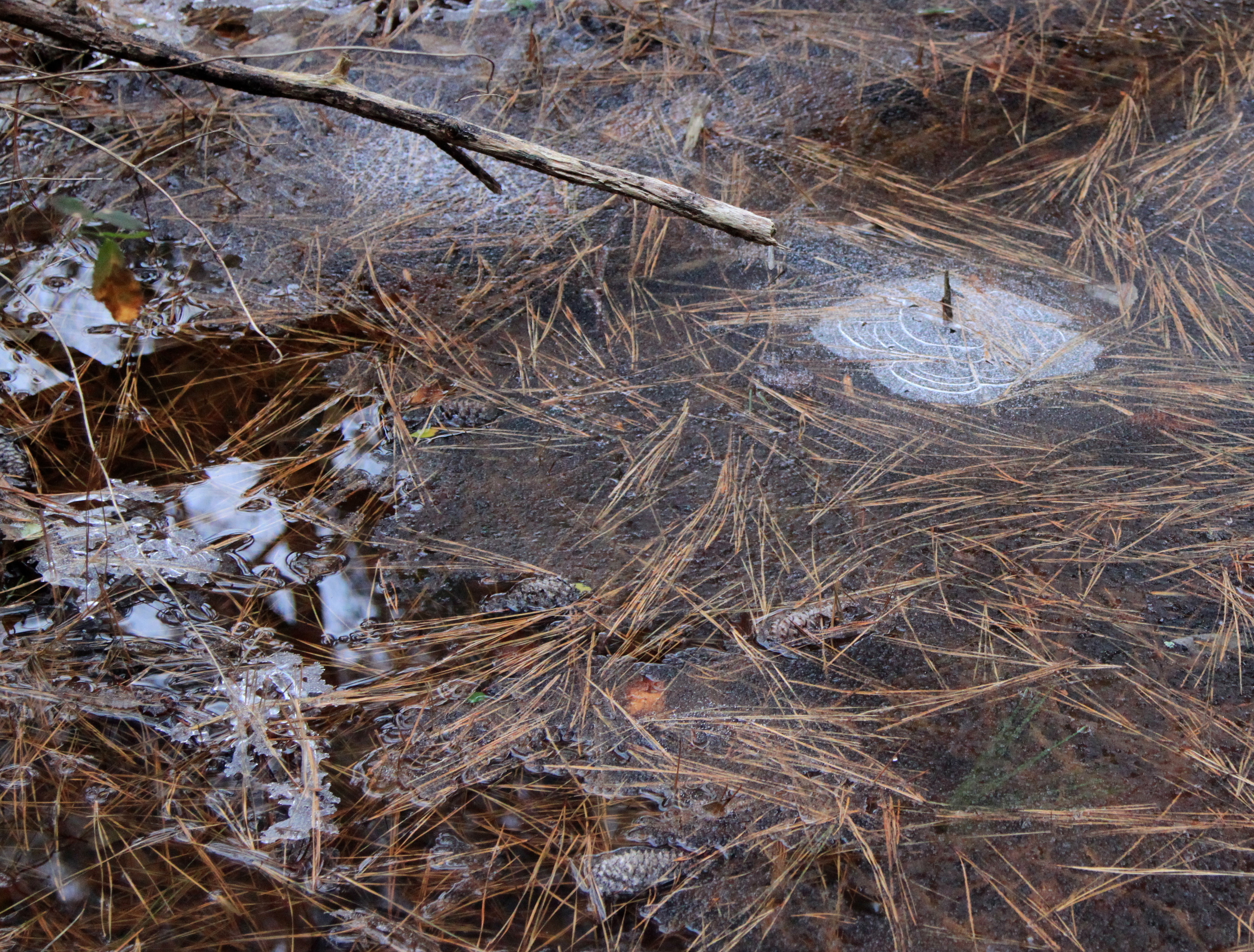
For much of the weekend, the temperatures hovered just above freezing. With near constant rain, this brought uncertainty and for some, anxiety, of freezing, icing and power outages. The weather was at an edge, a fine line between serious difficulty and simple wet and cold. Until Sunday the weather never hit that tipping point.

For several, learning to sit with the uncertainty of what was to come, to allow the situation to unfold in accordance with nature, was a practice in letting go. On Sunday at daylight we could see the trees and some areas of the grounds beginning to freeze as the rain pounded down. It was beautiful and many brought their cameras out during the break as the rain finally stopped. Others grew concerned about transportation and possibly traveling home on icy roads. Fortunately, though, the freeze was short lived. Worries faded as warmer temperatures melted most of the ice by mid morning. One person shared at the closing how her mind had become caught in anxiety, the “what if’s” of the weather, yet ultimately she could see her fear with some humor and let it go.

If we are practicing sincerely, we often find interior edges, places of uncertainty and doubt that limit and confine us. This is particularly true at retreats when we are spending considerable time meeting our present moment experience in its endless flux. Retreats are designed to bring us to our edges, to face the limits we imagine we have, then to find a way through those limits until they simply dissolve. But first we need to recognize the voice that tells us we’ve reached our threshold and can go no further. This awareness is the starting point. Then we can see that the narrative is composed of thoughts, not special, incontrovertible truths. As our resistance falls away, we also touch the fear and anxiety that often accompanies these thoughts.

Sometimes we do need to back off and take a break, to step away from our edge. But as soon as we find our courage and compassion, we can begin again. As we move back to our edge, letting go of our hesitation and any thoughts of doom, we begin to loosen our self imposed limits. The boundaries of our beliefs, the ideas that inhibit our direct experience of the dharma, of life itself, begin to soften. Ultimately, the “I” that holds us back dissolves into open space. This release from our false limitations liberates us, opens us to the joy of interconnection and true intimacy with this moment.

Frozen Pond

Frozen Pond

IMG_4084

Misty Ice at Bethany Hills

Misty Ice at Bethany Hills

Cleaning Up the Junkyard

Over time, if we don’t cultivate awareness through a consistent mindfulness and meditation practice, our minds may become cluttered like a junkyard. Maybe long ago the junkyard was just a pretty field in the country surrounded by trees, grass, and flowers in the spring. Then gradually we began to collect old thoughts, like tarnished, broken down cars. If we grow too accustomed to them, we may even cling to them like ancient treasures.

Slowly they begin to rust and old fluids leak into the ground, polluting the soil so that nothing can grow. But we may not even notice until the day we decide to plant a garden. Taking a fresh view of the yard, all we can see is junk from one end to the other: not one spot for planting

 With this perspective we have to take a closer look at our collection of old thoughts and beliefs, to find a way to make space for a garden. But how? It’s not as simple as doing a quick clean up and replacing all the old rotting cars we’ve accumulated for years or decades with a nourishing vegetable garden. We have to start with what we’ve already got—to take time and really see the junk in the yard, to spend time with it, to live there for while. Not to drink the contaminated water in the ground, but to make our way through the clutter, to see each and every thing we’ve clung to and refused to let go.

The amazing thing about this practice is that we don’t need to make an aggressive project of clearing out the junkyard, even if we’re totally surrounded. Once we begin the practice of genuinely seeing our mess, but not adding to it, the debris begins clearing out on its own. Soon there’s a little spot for a garden, and new plants grow that nourish us. Pretty soon the field has more open patches as the junk inhabits a smaller space. Some debris is still there, and that’s ok. We don’t have to have to clear the entire yard to begin growing our garden. Even if we’re still left with some old hardware, we may appreciate the patterns and colors of the rust, and we may find uses for the old tires.  Perhaps a tree swing would be nice, just over the garden.

 IMG_8609

A bird in a secluded grove sings like a flute.

Willows sway gracefully with their golden threads.

The mountain valley grows the quieter as the clouds return.

A breeze brings along the fragrance of the apricot flowers.

For a whole day I have sat here encompassed by peace,

Till my mind is cleansed in and out of all cares and idle thoughts.

I wish to tell you how I feel, but words fail me.

If you come to this grove, we can compare notes.

Ch’an master Fa-yen

The Joy of Mindful Photography

I originally posted this article last July and decided to re-post it now as I have another photography and meditation workshop coming up on October 5 at Penuel Ridge Retreat Center. If you’re in the Middle Tennessee area, I hope you can join me. Info is here.

As a visual artist, painting was my primary form of expression for many years. It still plays a large role in my creative retinue, but over the last several years I have discovered and fallen in love with mindful photography. This type of shooting, also known as contemplative photography,  is accessible to anyone who cultivates mindfulness in their lives – no special equipment or technical skills are needed.

Many people think of photography as an activity that creates separation from present moment experience because the photographer is always seeking that perfect shot.  From this perspective, the great shot is always in another moment, something to strive and search for. But every good photographer knows the value of training the mind to be completely present and aware in each moment, where great shots often reveal themselves, no seeking required.

When I use my camera in a receptive and open state, my shots reflect how the moment presents itself in its myriad, ever changing forms. I’ve found that this approach yields unexpected results that often differ from conventional shots. Advanced camera equipment isn’t important; being present and open is.  A simple, yet profound joy arises as my sense of “I’” as the photographer dissolves into the alliance of mind and heart, camera and surroundings. When the shoot is complete, I am always deeply relaxed and refreshed.

One of my favorite places for contemplative photography is Reelfoot Lake, in West Tennessee. In mid to late summer the lake is covered, even clogged, with huge yellow lotus flowers. Often the park rangers have to thin the plants out a bit. The endless vista of lotus flowers across the lake is truly an amazing sight. Locally my favorite place is Radnor Lake, just a block from my home. I can go any time of year and enjoy the ever changing weather conditions and seasonal transitions. To me, they are all beautiful although I have a special affinity for foggy mornings and icy winter afternoons.

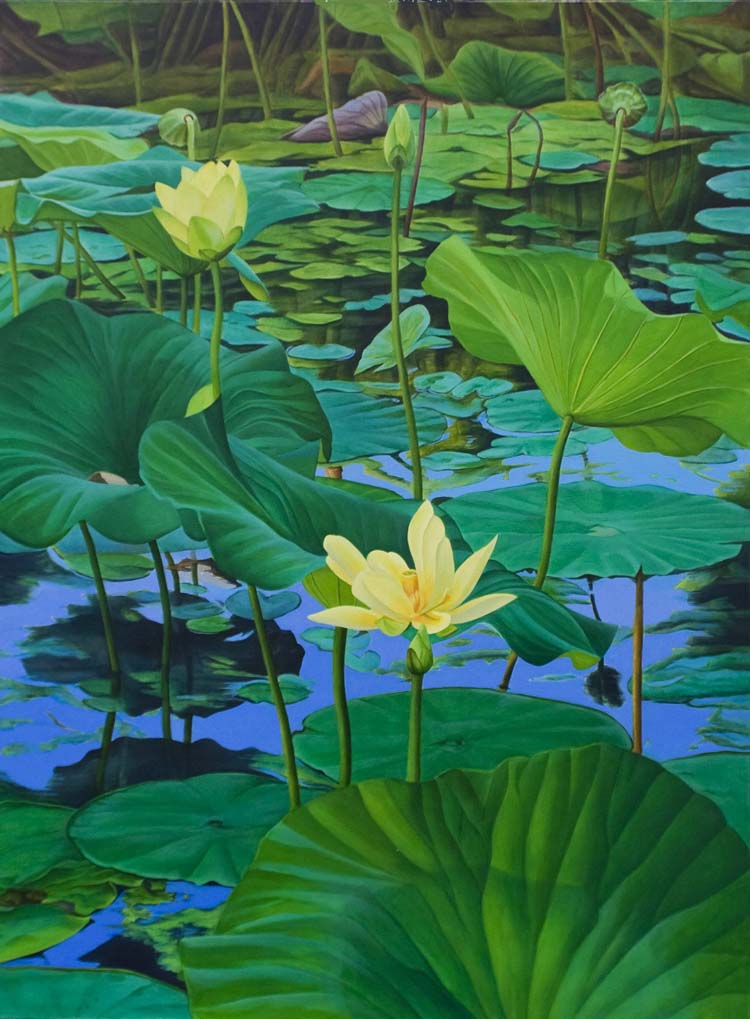
Although I use my photographs as the basis for many of my paintings, I do most shoots simply to experience the joy of the moment, immersed in my surroundings with a camera. Occasionally  an image stands out that I want to paint, such as this one, “Lotus Lake” from a shoot at Reelfoot Lake a few years ago:

Lotus Lake, Acrylic on Canvas, 48″ x 36,” private collection

If you’ve never experienced mindful photography before, I hope you’ll give it a try. All you need is a camera and an hour or two to shoot.  In September I plan on offering a meditation workshop where we will practice the art of mindful photography in a rural setting. The day will include meditation, photography and group interaction. No special photography skills are needed; any camera will do. I’ll post more details soon.

Reelfoot Lake at Dusk

Reelfoot Lake at Dusk

Balancing the Three Legs of Practice

I often think of dharma practice like a tripod, with three legs that create balance. On one leg there‘s meditation, including daily practice and retreats; on another is mindfulness in daily life; the third is sangha practice.

Let’s start with meditation. For many, establishing a consistent daily meditation practice is quite challenging. It requires making a commitment to carving out time to disengage from the ingrained distractions and patterns that inevitably arise in daily life.  Often when people say they don’t have time to meditate, it’s really that they aren’t making the time, which may otherwise be used to watch television or engage in online and other activities.  Meditation requires that we face ourselves, including all of our imperfections, leaving nothing out. Sometimes our sitting may be lovely and restful, even transcendent, at other times challenging and wobbly. But the key to a consistent practice is the willingness to receive all that arises in our awareness with an open and compassionate heart. This isn’t always easy, but its how the fruits of practice begin to ripen and transform our lives.

For the committed practitioner, meditation retreats are not a luxury but a vital part of deepening the practice. Concentrated time spent away from daily distractions helps us access parts of our minds and hearts that are otherwise out of reach; retreats help us contact our deepest evaded realities. If your life situation prevents you from traveling afar or carving out chunks of time for retreats, take advantage of daylong retreats as often as you can and shorter residential retreats that only last a weekend.

Practicing mindfulness in daily life is also vital to waking up. Some traditions emphasize sitting meditation and forget to focus on “off the cushion” practice. This creates an imbalance in the tripod; it can set up a firewall from everyday life. For our practice to deepen, we need to align what we learn in our seated practice with our daily lives. One of the best ways to bring mindfulness into daily life is practicing mindfulness of the body. This is a deceptively simple yet deep practice: Buddha said that mindfulness of the body leads to enlightenment. We’re so often caught up in our busyness, our activities and thoughts that we lose our connection with this moment. Our bodies are always right here, ready and available to serve as an anchor for our present moment awareness. Bringing mindfulness to your body is an uncomplicated yet powerful practice you can do throughout the day to root your awareness in this moment and disengage from reactive patterns and habitual thoughts.  You can still plan, think and carry out your activities, but you can do it all from a foundation more firmly grounded in presence and awareness.

Sangha comprises the third leg of the tripod. Sangha helps us create a stable support in our lives as we derive strength in our practice through sharing it with others. There is a notable, almost mysterious vibrancy that arises from meditating in a group setting. The collective energy of our concentration bolsters the individual and group simultaneously, allowing us to go deeper into our practice than if we only do it alone. Sangha practice also provides ample opportunities to practice generosity by contributing what we can to support the community of practitioners. We begin to break through the illusion of separation and realize that our practice isn’t only for ourselves, but for all beings. We also have an opportunity to view our habits, biases and aversions in the context of a group. The renowned Korean Zen teacher Seung Sahn likened sangha practice to cooking a pot of potatoes. He said that you could wash potatoes one by one or you could put numerous potatoes in a pot and stir them all together: they all rub up against each other, each getting clean in the process and rounding out the rough spots.

When our dharma practice is balanced it includes all three legs of this tripod. If we only focus on only one or two, we expend energy trying to maintain balance without a stable foundation. With our tripod in balance, however, we create the conditions for our practice to fully ripen and transform our lives, just as the Buddha taught.

A Three Way Stop of Awakening: Intersecting Dependent Arising, Equanimity and Emptiness

For many students of Buddhism, reaching an experiential understanding of equanimity and emptiness is quite challenging. Throw dependent origination into the mix and it may lead to all out confusion. But pulling the three together into an understanding of how we suffer and how we get out of suffering may simplify the matter.

Let’s start with dependent origination, also known as Buddhist psychology. Buddha taught that everything arises in dependence upon multiple causes and conditions, that nothing exists as a separate, independent object or entity, including ourselves. Because most humans perceive and react to circumstances as if there were an isolated, distinct cause, we easily become trapped in a chain reaction of suffering. We usually see a situation only through our personal viewpoint and conditioning, only a small part of what’s arising. If we then try to control, change or get rid of it, we create problems for ourselves and others. But when the illusion of a separate, independent self dissolves, we begin to see conditions more clearly. Our vision expands beyond our limited viewpoint, which leads to wise view, insight, and right action when necessary.

For example, when something arises, say, a twinge in your knee during a meditation retreat, you may initially tense against it, try to ignore it, or begin worrying that the pain will get worse. You may analyze where it came from, what you could have done differently, etc. Soon you are lost in and suffering. If you just return to the discomfort, see that it has already arisen, recognizing that many conditions led to that pain, and just let yourself experience it directly, you begin to dismantle the suffering. How? If you don’t nourish your reactivity through resistance and habitual thoughts, there’s nothing to feed your karma and ingrained patterns. The duality of you against the pain begins to dissolve. What’s left is an ever changing pattern of sensation. But you have to be willing to take down your protective veil of separation from the pain itself to reach this insight.

The protective veil arises from a sense of self against the external world. Our boundary of the skin, or somewhere just beyond that, creates a perception of separateness. Of course, that relative boundary is very important in many situations for protection and care of our health and well-being. But suffering occurs when we believe this boundary of self is fixed and unchanging. In reality our bodies and minds are constantly in flux and the concept of our identity is also subject to perpetual change. Just look back ten years and see if your identity, who you believe you are now and who you believed you were then, are exactly the same. There may be an underlying awareness or spark of life that feels unchanging, but is this something fixed to your self-identity?

Quite often, people who haven’t yet experienced no-self will call Buddha’s teaching on emptiness a concept. Yet how many of us refer to our sense of self as a concept? It’s easier for most of us to perceive the self as real and emptiness as an esoteric idea or concept. In reality, if we reverse the two we will be closer to a genuine understanding.

It helps when we can meet our experience, what arises in the moment, with equanimity. People often mistake equanimity for indifference or detached neutrality. But it’s actually the ability to stay present with our situation without reactivity, or if we do react, to see it and stop feeding it. If we experience a loss, for instance, meeting the pain of that loss with equanimity doesn’t mean we don’t feel the pain. Instead, we allow the arising of that pain without interference, and eventually it passes on its own.

To pull the three together, equanimity, dependent origination and no-self, I’ll share an example from my own experience. For many years I was in an unstable romantic relationship. I was sure he was “the one” and did everything I could to ensure his long term commitment. Yet, he kept pulling away. I would go through waves of pain and suffering whenever he left and rely on my therapist to help me find the root of the problem so I could get on with life.  She was quite helpful to me, yet each time I reached a point of acceptance, my boyfriend came back. Again and again I took him back into my life while ignoring the troublesome patterns inherent in our relationship. “This time things will be different,” I repeated like a mantra. Regardless of my hopeful attitude, our old patterns always reemerged along with his restlessness.

This pattern went on for a number of years.  Through therapy and meditation, I learned to work with my reactions, clinging and desires until significant space opened up. I felt more relaxed and less needy, I dated other men and felt relatively content. But just when I felt truly ready to get on with my life, he asked me to move in with him. Intuitively I knew it was a bad step. But the more I thought about it, the more I convinced myself that we had both changed enough to make it work. Soon, however, our new level of togetherness revealed our incompatibilities even more acutely. I stubbornly persevered until one night we had an irreconcilable disagreement. Suddenly all my years of effort and therapy, everything I did to make it work, came crashing down. I had been so focused on trying to control the situation, to make it right, to fix the “cause” of the problem, that I ignored the obvious and deeper conditions that prevented us from being compatible. In my limited view of the situation, I missed to the full spectrum of conditions that were beyond my control.

I had been blinded to dependent origination because I craved his attention so badly. I thought his love would complete my identity, my sense of self, even though living with him didn’t fulfill me at all. I finally saw the disconnect, the broader conditions that made our relationship incompatible. At last I had the courage to completely let go. I realized I had been holding on to a fixed idea of my identity as someone who needed to be in a relationship no matter how flimsy it was. And most of all, I was finally able to meet the situation with equanimity. The truth hurt but I didn’t push it away. I quit trying to cover it over with a worn out narrative about how one more step, one more effort at self improvement, would unlock the door to our love.

This awakening was one of the most liberating moments of my young adult life.  I realized that this “self” didn’t need someone outside of me to validate my very existence. There was nothing fixed about my identity; moment to moment my “self” was in flux, yet also worthy of kindness and compassion. This realization didn’t mean I quit longing for a loving relationship. But I realized that it wasn’t essential to my existence or happiness. Living this moment brought true fulfillment, with an open heart, in sadness and in joy. At last I could embrace my loneliness, my broken heart, something that had been with me long before I met and lost my “ideal” man. Through accepting that broken heart with equanimity I found for the first time in my life the joy I had been seeking for so long.

– Lisa Ernst