Joan Halifax on Mindful Photography

I found this blog post this morning and thought it was quite timely considering my last post about  mindful photography. This is Roshi Joan’s  own moving journey with a camera.

Seeing Inside by Joan Halifax

When I was a kid, I got really sick. For two years, I couldn’t see. It was then I discovered I had an inner world, and it was a visual one. Since I was born with two good eyes, I knew the visual experience. Then suddenly, one morning, I felt my way down the hall of our house in Coral Gables, Florida, my hand sliding along the wall, and told my parents that I couldn’t see.

A cascade of physical disabilities followed and after a while disappeared. During the time when I was in bed, recovering from an unidentified virus, another world opened up to me. I began to re-create the outer world inside of me; I began to see inside.

When I got better, my mother and father gave me a Kodak Brownie Box Camera. Just as my interior life had appeared to me when I was sick, here was a little box that would capture what I saw. It could see inside. I was fascinated, and I was hooked. And I began to photograph the world that caught my eye, beginning from the age of six on, and now I am 70.

Today, a collection of nearly a hundred thousand photographs exists, a thread of images that span time and the world. When I was a kid, I photographed my handsome father standing proudly beside his Lincoln Continental. Soon thereafter, I photographed Cologne Cathedral with my Brownie. The haunting black and white image captured a heavy sky hanging ominously over the bombed cathedral. Recent photographs portray the faces of Tibetans, riven with the elements, Burmese elders, incandescent with innocence, and the landscapes of Zen and the Himalayas.

I never cared about or studied f/stops and shutter and film speeds. I only cared about composition and connection. I never took a class in photography, though I had friends who were great photographers, including Robert Frank, Ralph Gibson, Julio Mitchell, and others. I thought Diane Arbus was nothing but courage, and met her several times when I lived in New York. I was a huge fan. I loved the work of Ansel Adams and traveled with his daughter. Dorothea Lange’s photographs always took my breath away, as did the work of Gordon Parks and Eugene Smith. In the 70’s, I stayed in Eliot Porter’s house on occasion in Tesuque, and studied his work. More recently, the photographs of Matthieu Ricard show a view of space and light that is resonant with my Buddhist practice. Yet, though the work of other photographers interested me, I had no interest in emulating anyone. I just did my own thing, privately and joyfully, capturing light, seeing inside

As I lived with the camera, the camera was not only my eyes but also my heart. It captured and held light, light that I was always seeking and finding, light that filled the world, even the world of suffering, when light shines through the darkness.

When I was in my twenties, I discovered meditation. What a surprise! It was not so different than the gift of my childhood blindness. I could, through meditation, see inside. I could also see the world in a different way, a way the camera had taught me. The camera had given me a view, a view that accepted everything into its lens. I had a viewfinder (meditation), and a way to develop the world or action. View, meditation, action are one way that Buddhism is described. It is a summary of the Eight-fold Path of the Buddha. And it was to become my way of life, and the life I have followed and noted through my friend, teacher, and constant companion, the camera.

June 13, 2012
Prajna Mountain Forest Refuge

The Scientist and The Baker

By Lisa Ernst

Most people who take up meditation will find over time that they are drawn to a particular practice style that becomes their foundational approach. Usually the approach will tend either toward what I call the “scientist” orientation or the “baker” orientation.

The scientist gets to know the object of his or her study through objective observation. This is a classic Vipassana style of practice, where the meditator uses an object of concentration to still and focus the mind. The value of this practice is in allowing the practitioner to observe arising phenomena such as physical sensations, emotions and thoughts without becoming swept away by attachment, aversion and personal identification.  Through committed practice, the meditator gains experiential insight into impermanence, suffering and no-self.

Bakers like to get their hands dirty, to put them in the flour and other ingredients and work with them as an extension of their bodies.  Through repeated practice, bakers lose the separation of themselves and the ingredients, diving deeply into immediate experience of baking.  In meditation, this style is known as direct experience, where the meditator immerses him or herself in whatever is arising and becomes “one” with it, losing a sense of fixed self and dissolving into emptiness. This sometimes challenging approach is associated with Zen and certain Tibetan forms of meditation, although it can be found in some Vipassana approaches as well.

I use the analogy of baking because, unlike other forms of cooking, it is a science. Without very specific ingredients in measured quantities, baking will fail. So without the underlying science to support the recipes, bakers won’t achieve successful outcomes.  Conversely, bakers provide sustenance for the scientists, resulting in a mutually beneficial relationship.

Although most meditators tend toward the scientist or baker style as their primary practice orientation, often they move between the two as needed as they become more experienced.

Which practice approach most closely fits your own?

“Seekers who disdain clamor to seek quietude are as it were throwing away flour but seeking cake. Cake is originally flour, which changes according to use. Afflictions are none other than enlightenment.”

–Pao-Chih, from THE ZEN READER

Taking the Seat of Truth

Taking the Seat of Truth

by Lisa Ernst

Recently I was invited to lead an opening meditation at a regional 12 Step retreat. Everyone there was eager and interested to spend several minutes in silent meditation. As I scanned the room during the meditation, I saw the faces of nearly everyone there in quiet repose. Afterward, many people sought me out to comment on how helpful those quiet moments were before launching into the activities of the day. This experience led me to reflect on Buddhism and the 12 Step program, although I’m not necessarily comparing all of their compatibilities and differences. There are some good books available on that topic already. What I’ve been reflecting on is how the 12 Step programs are another avenue to paying attention and shedding light on those parts of ourselves we’d rather not see. What’s required at 12 Step meetings is courageous honesty. Which is, of course, what we cultivate in meditation if we’re practicing sincerely.

I starting attending 12 Step meetings several years ago and went regularly for about three years. The most familiar 12 Step program is Alcoholics Anonymous, but many other 12 Step meetings exist to support those struggling with addition and the fallout from addiction. I wasn’t personally attending to address substance abuse problems, though some would kindly argue that my chocolate addiction could bear that kind of scrutiny. But since dark chocolate has now been classified as a health food, happily, I’m not fighting that one anymore. Instead, I began attending the 12 Step program to address interpersonal issues that arose in part from growing up in a family of alcoholics. At a deeper level, I believe many of the challenges I’ve faced in my life are part of the human condition; they are things most of us grapple with, whether we have substance abuse in our families or not. At the root is the very clinging and aversion of the mind that Buddha struggled with in his quest for enlightenment. On a practical level, I found the 12 Step program assisted me in working with the lasting effects of my upbringing in an alcoholic family. This is something meditation practice alone didn’t fully address.

What I have discovered from many years of practice is that meditation alone rarely succeeds in fully opening the gates of the mind and heart, even though it is a powerful way to illuminate much of what’s been hidden within us. Buddhist meditation (on and off the cushion) is my foundational path and it has made a profound difference in my life. Along the way, however, I have utilized several adjunct paths such as psychotherapy, support groups and 12 Step programs to augment and deepen my practice. I have found that any path that encourages me to face and tell the truth about my life, and find the courage to respond in a more constructive and compassionate way, will only serve to enhance my dharma practice.

The first 12 Step meeting I chose to attend was in Franklin, Tennessee, a town about thirty minutes outside of my hometown of Nashville. The meeting’s start time meant I had to drive to Franklin during rush hour traffic. That alone was a good practice in patience for me as I’ve never welcomed long commutes. The nearly interminable waits at countless traffic lights also led me to question why I was giving up another evening during the week when I could be home doing, what? Maybe reading a magazine or watching one of my favorite chefs on the Food Network? Ok, maybe not such a good argument to stay home. I also questioned whether the meetings would be so far removed from Buddhist practice as to feel alien and incompatible. As I mulled these questions, a twinge of anxiety arose and I nearly convinced myself to turn around and go home. But my years of meditation practice allowed me to recognize the voice of anxiety without getting caught in it. So I stayed my course to Franklin and attended the meeting.

When I arrived, I was greeted by many welcoming and friendly faces and I immediately felt at home. During the first meeting I kept quiet and just observed, but I appreciated the honesty and courage of the people in the room. They were clearly committed to telling the truth about their lives and exposing the hidden parts of themselves that led to suffering and even destructive behavior. Everyone who speaks at a 12 Step meeting must share directly from their own experience rather than from a conceptual understanding of their suffering. This direct and honest sharing is nearly always met with empathy and acceptance by the others in the room. There is no room for judgment. This allows an atmosphere of honesty to flourish. Twelve Step groups also cultivate a sense of community and compassionate support, much like a Buddhist sangha. Moments of meditation are often included in 12 Step Meetings, although most of the time is spent in group sharing.

Over the course of several meetings, I found myself responding to the emphasis on personal experience and honesty in a way that helped me with my own struggles. The approach felt quite compatible with my own Buddhist practices. Soon the meetings became a regular part of my week and I even made several new friends. Most evenings just as I took a seat at the meeting, a moment of awakening would occur: my mind would become clear and I would see something within my own heart that had been obscured. Often from these insights I would discover ways to begin undoing old patterns that had kept me locked in suffering. Sounds much like dharma practice, doesn’t it?

The word “dharma” actually has dual meanings. In the Buddhist tradition it has come to signify the Buddha’s teachings, while also pointing to “the truth of this moment.” For me, attending 12 Step meetings created a new avenue to work with difficult emotions and old patterns within the context of my dharma path. Although not a substitute for meditation, the meetings provided another way to experience the truth of this moment.

After attending 12 Step meetings for several years I found that I was less bound by the effects of my upbringing in an alcoholic family. I had become more at ease with others and the old stories of pain and despair that swirled in my mind had diminished to a whisper. I realized the meetings had served their purpose and it was time to move on with gratitude and appreciation.

How Sticky Are You?

By Lisa Ernst

When I was in my late teens and early 20′s I suffered from agoraphobia, which literally translates into “fear of the marketplace.” This is an apt description; I had arranged my life so that I would have no need to interact with humans in any way, shape or form, except for one thing – I had to go to the grocery store. Encountering grocery store clerks at the check out line was usually very painful for me as I was convinced they were judging me, laughing at me and talking about me after I left. These encounters would linger or “stick” to me for days as I replayed them again and again, ingraining more deeply my own misguided perceptions of how the world saw me.

Obviously I had emotional and psychological issues that I needed to address, but most of us experience some version of this on a regular basis – encounters with others that stick to us long after they’re over. If we’re not mindful of what we’re doing, we end up trading our equanimity for replaying these situations again and again, until they become fixed in our minds as reality. There is an enduringly popular Zen parable that points to this kind of “stickiness”:

Two traveling monks reached a river where they met a beautiful woman. Wary of the current, she asked if they could carry her across. One of the monks hesitated, but the other quickly picked her up onto his shoulders, transported her across the water, and put her down on the other bank. She thanked him and departed.

As the monks continued on their way, the one was brooding and preoccupied. Unable to hold his silence, he spoke out. “Brother, our spiritual training teaches us to avoid any contact with women, but you picked that one up on your shoulders and carried her!”

“Brother,” the second monk replied, “I set her down on the other side, while you are still carrying her.”

Meditation and mindfulness practice offer us a great opportunity to assess how often human encounters “stick” to us after the actual moment of interaction has passed. Through committed practice, we can awaken to the amount of time we invest in rehashing past events while deepening grievances and other emotions at the expense of living in the present moment.

I began reflecting on this one day when I received an upsetting rejection letter from a gallery owner in New York. Two weeks earlier she had emailed me personally, saying she had found my website, was impressed with the quality of my art, and she invited me to submit my portfolio for an upcoming show. I was busy working on a commission at the time but I squeezed in several hours to prepare and send a portfolio. I enjoy visiting New York City so I was excited about the opportunity.

Two weeks later, I received a boilerplate rejection letter without even the gallery owner’s signature, saying “your work is not the right fit for our gallery.” I was insulted at the impersonal nature of this letter considering her initial solicitation, not to mention the time I invested in preparing a nice portfolio for her. It felt like a slap in the face.

Later that day I was running some errands when I realized that I was barely noticing my activities. I was lost in frustration at this woman. She was “sticking” to me and weighing me down as I carried her with me through my day. This moment of waking up, of seeing into my mind pattern, led me to look more closely and inquire into my heart as to what kept me holding on to her. This wasn’t an intellectual question, an attempt to figure it out mentally. The question was aimed at my present moment experience of entanglement. I could clearly see that I had been trapped in my outwardly directed grievance, attached to the idea that she should have responded differently. This insight enabled me to let the attachment go and open fully to my immediate experience, to feel my disappointment, to let it be “just like this.” My mind and heart softened into the present moment. As the knot of disappointment untangled, it was clear that no further thought or response was necessary, so I put her down and continued with my day.

The Lotus Blooms in the Mud

by Lisa Ernst

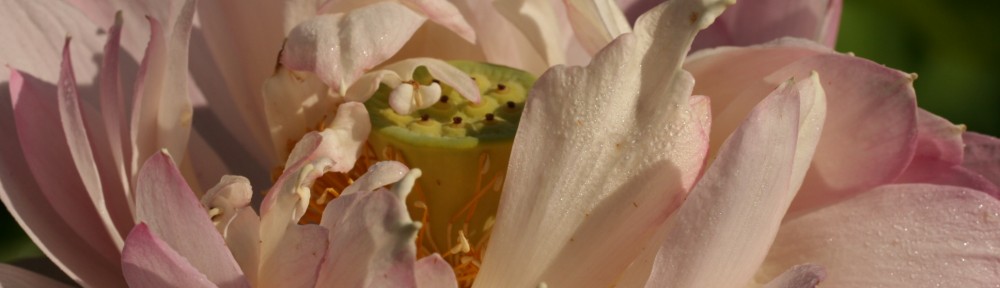
The lotus flower is revered in Buddhist lore because of the way it grows and blooms. Lotus plants thrive in muck and mud, yet they produce some of nature’s most glorious flowers. The Buddha taught that the muddy, murky condition of the mind is the very place where our own Buddha nature thrives. We don’t need to eliminate this imperfection to awaken to our true nature.

Recently I became aware of a specific situation in which this teaching manifests clearly in my own life. I live within walking distance of Radnor Lake, a beautiful state park that is pristine and peaceful when it’s not packed with people. Because its so close, I exercise on the trails at Radnor several times a week. Often in the rainy season the hiking is muddy and the crowds are a bit smaller; no doubt many want to avoid stepping in the muck and getting their shoes dirty. This doesn’t prevent me from hiking as I know its part of the experience, but I still find myself trying to avoid the muddiest parts.

Usually I arrive sometime in the afternoon, hoping to beat the after work crowds. I’ll hit the trail at a brisk pace, with little intent of communing with nature, often mentally engaged in whatever is going on for me that day. My mind is often moving as fast as my body. I’ve done this for so many years now that I’ve ingrained a pattern of launching my hikes nearly oblivious to the beautiful sites around me and the joys of nature. Yet, seemingly in spite of this, Radnor Lake is where I have many of my deepest “off cushion” insights.

Some people who are hiking alone at Radnor talk on their cell phones or listen to their iPods, apparently uninterested in enjoying the simple sounds of nature. Others may come here with the express desire to walk mindfully along the trails. This can be a nice practice in and of itself, but it may only offer a brief respite from our often overactive minds. For me, without life’s usual external distractions, the intensity of my thoughts and feelings becomes more apparent to me as I hike. I’m often immersed in the muck, regardless of whether the trails are muddy or dry. Yet this immersion in my human imperfection provides the ideal opportunity for me to access my wisdom.

If we hold on to an idea that only peaceful mindfulness is appropriate at a place like Radnor Lake, we block our chance to truly enter our own great nature. Ideals like this can be used to resist what’s truly present. When I first began to notice how unsettled my mind was during my hikes, I tried various means to fix it. I brought mala beads to Radnor and I tried to practice metta along the trails. Although I didn’t realize it at the time, my intention with these practices was incorrect: I was seeking a way to shut down my discomfort rather than to use the practices as skillful means to open heart and mind. Needless to say, they didn’t work and I abandoned the effort. One benefit of practicing sincerely over time is that we begin to discern more quickly whether we are using a particular practice skillfully or to resist and repress what’s really present.

It takes courage to face ourselves just as we are, to let go of a spiritual ideal and to reside in the midst of our own human imperfections with no distractions. Now when I hike at Radnor, I recognize that the path to clarity and equanimity is right in the midst of my own unsettled mind. When I am willing to pause long enough to genuinely touch the tenderness, the anxiety or fear that often accompanies a mind full of thought, the sounds and sights of nature become vividly alive. This softening and presence of heart may bring a tear or a smile, but the spinning of my mind simply stops in the midst of this moment. At this juncture, each step along the way, whether the trail is dusty and dry or squishy with mud, happens with effortless presence and gratitude. Whatever I was struggling with clears and is no longer a problem to be solved. The lotus indeed blooms in the mud.