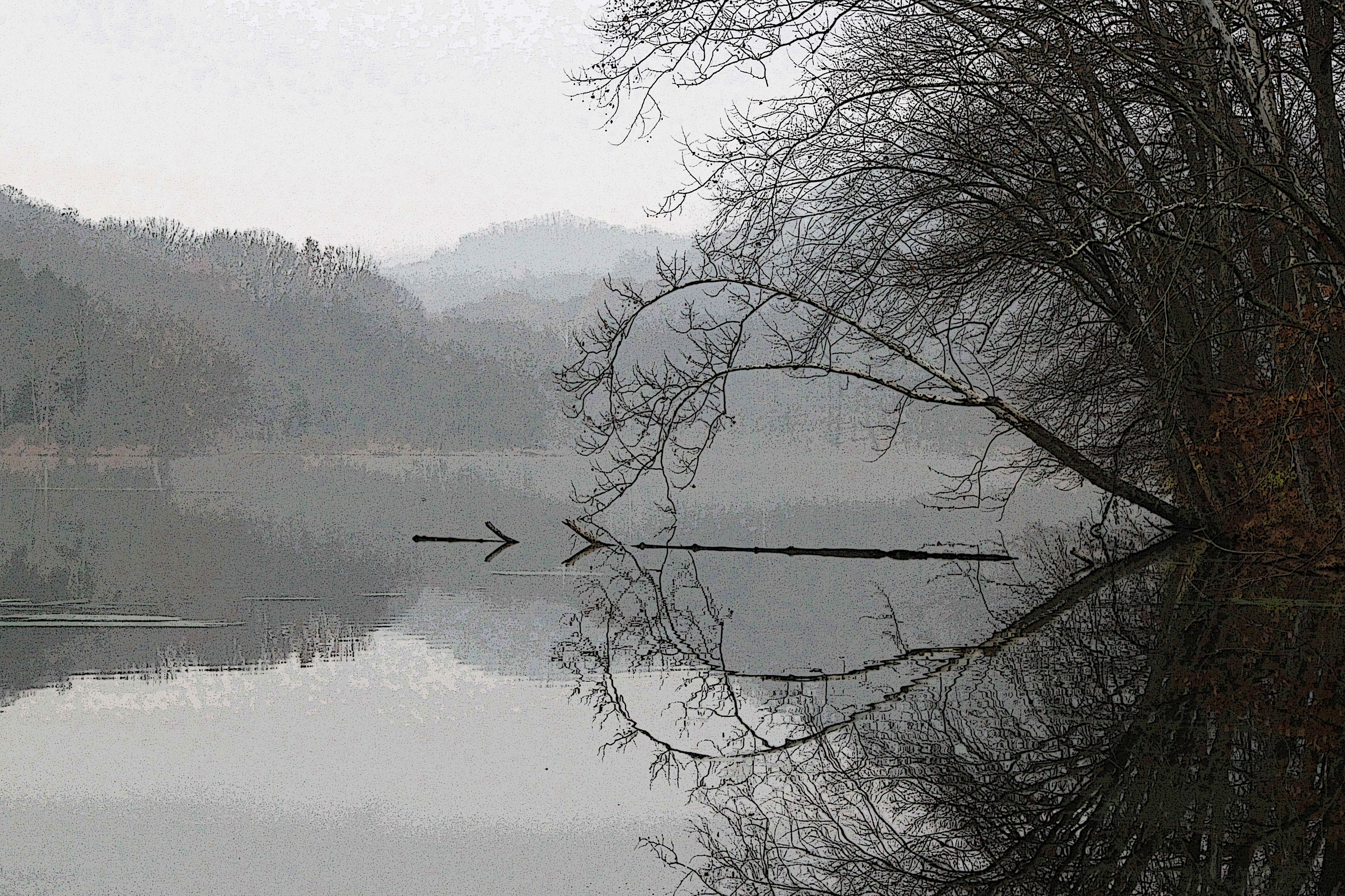
“Your task is not to seek for love, but merely to seek and find all the barriers within yourself that you have built against it.”
― Rumi
“Your task is not to seek for love, but merely to seek and find all the barriers within yourself that you have built against it.”
― Rumi
This morning I read an article from Ajahn Sumedho that inspired me to post this excerpt about our shared humanity. Thanks to Geoff Lovettf for the link.
In Thailand they say: “Brothers and sisters in suffering, old age, sickness and death.” When we think of ourselves as brothers and sisters in old age, sickness and death, we stop the foolishness. But if we want to build up an army to fight, we can’t say we’re brothers and sisters in old age, sickness and death. We have to say, `Those people over there are demons. The more you kill, the better. They don’t have any feelings. They like to bayonet babies and butcher old women. They have no respect for anything.’ And then you think, `Oh, I’m going to kill them.’ Propaganda is like that. It’s a way of making you think the best thing you can do is kill them. But in reflective knowledge we see the common bond — from the most despicable human being to the most saintly. That is a reflective teaching. We think, `Yes, yes, that is the truth. When you think about that — brothers and sisters in old age, sickness and death — we’re all getting old and . . . ‘
Excerpted from Brothers and Sisters in Suffering, Old Age, Sickness and Death by Ajahn Sumedho.
“Allow dark times to season you.” Hafiz
25 years ago I took a hesitant step into a psychiatrist’s office. My boyfriend at the time was worried about my mental state and urged me to seek help. My grandmother had just died, preceded in death by my mother and my father. My grandmother was my last close family connection and I felt utterly alone. I had no idea what was happening to me as I sunk further and further into a dark hole of despair.
The psychiatrist said I was clinically depressed and wanted to prescribe anti depressant meditation. This threw me. I had been living with depression for so many years it seemed like an irreparable part of me. I had come to accept that I was chronically depressed and perhaps always would be. But as we talked, and I assessed my mental state more objectively, I knew in my heart that I couldn’t go on this way any longer. At that very moment I decided I would try meditation. I let the shrink know I would not be taking him up on his offer of medication, but I did agree to begin seeing a psychotherapist to help me deal with childhood trauma and grief from my losses. This was a vital step for my mental well being. But I knew therapy alone wouldn’t be enough. In fact, my new therapist was very supportive and encouraging that I had begun a meditation practice.
Taking up meditation was an easy decision for me. Looking back, I have no idea why I was so confident. 25 years ago there wasn’t nearly the volume of information on meditation and the brain that there is now. But I had always been inspired by Buddha’s emphasis on meditation as a part of the path to freedom from suffering. Intuitively I knew meditation was for me, but I also knew I would have to commit myself to the practice with my whole heart.
As a meditation teacher I frequently meet people who are seeking relief from stress and depression through meditation. Often they’ve read encouraging studies and scientific papers and they hope to see the same results. But it works for only a few. Its not that meditation isn’t effective; what I’ve consistently observed is that only a small number of people truly commit to the practice wholeheartedly. If relieving depression is the only reason to meditate, most people will become impatient and doubtful too soon to experience any significant change. Others will practice only sporadically, yet still expect results. This won’t work.
For some, meditation isn’t the right path, at least not initially. Certain mental illnesses need to be treated clinically and sitting in the midst of grief and depression may overwhelm or intensify anxiety. Some may combine medication with meditation initially. Longer term, meditation can be a wonderful way to further steady the mind and begin to see and relieve the roots of human suffering, of clinging and aversion.
When I began my meditation practice, I committed to sitting a minimum of 30 minutes each day. I gave myself no leeway at all on this. No matter what, I meditated daily. Sitting through grief, anxiety and fear, along with joy, equanimity and bliss. The practice itself stabilized my mind enough that I could stay present in my experience without being overwhelmed. As Thich Nhat Hanh explained, “when we go home to ourselves with the energy of mindfulness, we’re no longer afraid of being overwhelmed by the energy of suffering. Mindfulness gives us the strength to look deeply and give rise to understanding and compassion.”
I quickly forgot about whether meditation was helping with my depression. I became so interested in the process itself that my mental state actually took a back seat. Not that it was unimportant, but it wasn’t my primary focus. Studying and seeing my mind, as well as the world around me, in such an intimate way each day fascinated me. Those moments when I broke through a barrier to deeper insight into my heart and mind had a liberating and profound effect on me.
Gradually, almost without even noticing it, my depression lifted and I became less isolated and lonely. Even today, daily meditation is a foundational element of my mental health even though it isn’t the primary reason I’ve continued to practice.
Some people will take up a serious meditation practice at a very dark and desperate time in their lives and it works – they begin feeling better and slowly their meditation practice falls away. Maybe it was all they needed and they had no further aspiration with this form of practice. Personally I’m glad I didn’t stop. I so appreciate the clarity that arises when I witness and experience the myriad manifestations of thought and emotion I encounter. Most of all, this path has helped me deepen compassion for myself and others, to pierce the illusion of a separate self, which allows me to be more kind, open and receptive to life in its ever changing forms.
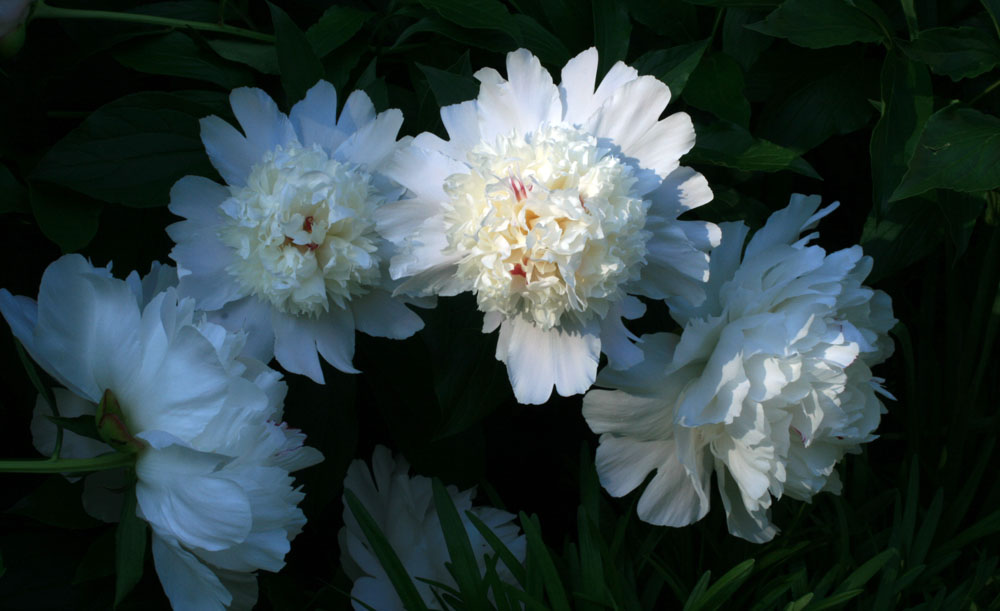
The temple bell stops.
But the sound keeps coming
out of the flowers.
– Basho

White Egret in Open Sky
photography by Lisa Ernst
I often encourage practitioners who are struggling, tied up in knots and feel stuck with nowhere to run, to surrender and put their heads in the mouth of the demon. Its one of my favorite teaching metaphors because its so vivid and unambiguous. From some this image draws stunned silence or a wince; from a few others a slight smile and a nod. Even though many practitioners reach an intellectual understanding, I’ve found that only a few fully experience the liberation that comes from an intimate view inside the demon’s mouth
This metaphor arises from an anecdote about the Tibetan yogi Milarepa. Here’s the story from Tara Brach in her book, Radical Acceptance:
The great Tibetan yogi Milarepa spent many years living in isolation in a mountain cave. As part of his spiritual practice, he began to see the contents of his mind as visible projections. His inner demons of lust, passion, and aversion would appear before him as gorgeous seductive women and terrifying wrathful monsters. In face of these temptations and horrors, rather than being overwhelmed, Milarepa would sing out, “It is wonderful you came today, you should come again tomorrow … from time to time we should converse.”
Through his years of intensive training, Milarepa learns that suffering only comes from being seduced by the demons or from trying to fight them. To discover freedom in their presence, he has to experience them directly and wakefully, as they are.
In one story, Milarepa’s cave becomes filled with demons. Facing the most persistent, domineering demon in the crowd, Milarepa makes a brilliant move—he puts his head into the demon’s mouth. In that moment of full surrender, all the demons vanish. All that remains is the brilliant light of pure awareness.”
Most of us have ingrained responses to painful and difficult challenges. Usually these patterns involve resistance and struggle, which worsen our suffering. As the noose tightens, the problems may grow into unfathomable monsters that we must avoid at all costs. We create an “other” out of our suffering or we create an “I.” Either way, we start to view these conditions as problems we must solve or personal afflictions we must vanquish.
As committed practitioners, over time we become more skilled at meeting these challenges. Gradually we’re less fearful of our demons, at least some of the time. We have the space to explore them with less reactivity, maybe inviting them in for tea once in a while. The intensity of our suffering diminishes and the demons disperse. Yet at other times, a particularly menacing demon may return, bearing down on us with full force. At moments like these we may feel that nothing can save us.
The demon is staring us in the face and we’ve got nothing to stop it. We’re sure the demon will devour us if we don’t find a way to protect ourselves or escape. Fear consumes us. At this juncture I’ve found that the full act of surrender, of putting my head in the mouth of the demon is the true way to freedom. It’s not really something I do as something I let go of. I release my need to survive, to protect or preserve the idea of myself in any form at all. I’m willing to let what I dread devour me.
Although this might sound scary, ultimately it’s the opposite. The moment I let go, when the demon has entered me and I have entered it, the demon dissolves into open space. I dissolve into open space. There’s nothing inside or outside, only the sweet, unobstructed stillness of this moment. Gradually wisdom arises out of this emptiness. The situation reveals itself; the delusion dies.
There’s an important place for compassion in this process. Sometimes we’re just not ready or able to move closer to the demon or even invite it in for tea. Taking a step back and offering lovingkindness to ourselves and to the fear, even the demon, can soften us. When we’re truly not ready to meet the darkness directly, we need to soften our hearts and minds into kindness and compassion. Then gradually we’ll find our way to the next step, of giving all of ourselves to the demon. At last we see it’s all a grand illusion and the demons of suffering and fear transform into equanimity and openness.
In a moonlit night on a spring day,
The croak of a frog
Pierces through the whole cosmos and turns it into
a single family!
-Chang Chiu-ch’en

Frog in Spring
I often think of dharma practice like a tripod, with three legs that create balance. On one leg there‘s meditation, including daily practice and retreats; on another is mindfulness in daily life; the third is sangha practice.
Let’s start with meditation. For many, establishing a consistent daily meditation practice is quite challenging. It requires making a commitment to carving out time to disengage from the ingrained distractions and patterns that inevitably arise in daily life. Often when people say they don’t have time to meditate, it’s really that they aren’t making the time, which may otherwise be used to watch television or engage in online and other activities. Meditation requires that we face ourselves, including all of our imperfections, leaving nothing out. Sometimes our sitting may be lovely and restful, even transcendent, at other times challenging and wobbly. But the key to a consistent practice is the willingness to receive all that arises in our awareness with an open and compassionate heart. This isn’t always easy, but its how the fruits of practice begin to ripen and transform our lives.
For the committed practitioner, meditation retreats are not a luxury but a vital part of deepening the practice. Concentrated time spent away from daily distractions helps us access parts of our minds and hearts that are otherwise out of reach; retreats help us contact our deepest evaded realities. If your life situation prevents you from traveling afar or carving out chunks of time for retreats, take advantage of daylong retreats as often as you can and shorter residential retreats that only last a weekend.
Practicing mindfulness in daily life is also vital to waking up. Some traditions emphasize sitting meditation and forget to focus on “off the cushion” practice. This creates an imbalance in the tripod; it can set up a firewall from everyday life. For our practice to deepen, we need to align what we learn in our seated practice with our daily lives. One of the best ways to bring mindfulness into daily life is practicing mindfulness of the body. This is a deceptively simple yet deep practice: Buddha said that mindfulness of the body leads to enlightenment. We’re so often caught up in our busyness, our activities and thoughts that we lose our connection with this moment. Our bodies are always right here, ready and available to serve as an anchor for our present moment awareness. Bringing mindfulness to your body is an uncomplicated yet powerful practice you can do throughout the day to root your awareness in this moment and disengage from reactive patterns and habitual thoughts. You can still plan, think and carry out your activities, but you can do it all from a foundation more firmly grounded in presence and awareness.
Sangha comprises the third leg of the tripod. Sangha helps us create a stable support in our lives as we derive strength in our practice through sharing it with others. There is a notable, almost mysterious vibrancy that arises from meditating in a group setting. The collective energy of our concentration bolsters the individual and group simultaneously, allowing us to go deeper into our practice than if we only do it alone. Sangha practice also provides ample opportunities to practice generosity by contributing what we can to support the community of practitioners. We begin to break through the illusion of separation and realize that our practice isn’t only for ourselves, but for all beings. We also have an opportunity to view our habits, biases and aversions in the context of a group. The renowned Korean Zen teacher Seung Sahn likened sangha practice to cooking a pot of potatoes. He said that you could wash potatoes one by one or you could put numerous potatoes in a pot and stir them all together: they all rub up against each other, each getting clean in the process and rounding out the rough spots.
When our dharma practice is balanced it includes all three legs of this tripod. If we only focus on only one or two, we expend energy trying to maintain balance without a stable foundation. With our tripod in balance, however, we create the conditions for our practice to fully ripen and transform our lives, just as the Buddha taught.
There are lots of old Zen sayings, but this one in particular, which I saw posted on Facebook last week by Leisa Hammett, gave me a smile.
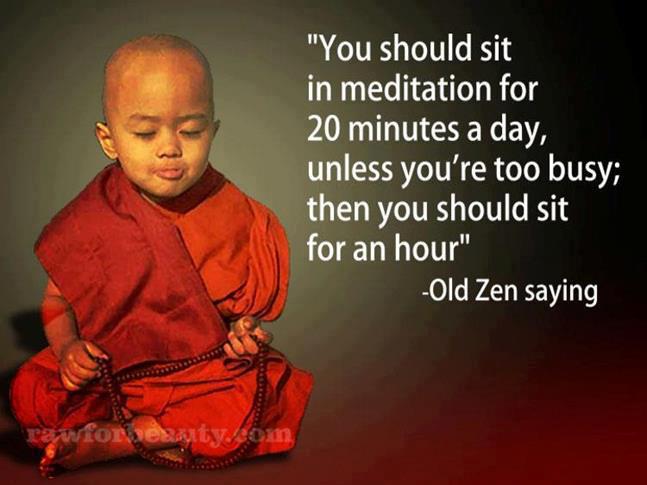 This reminds me a of blog post I wrote in a similar spirit, “Time Enough to Wake Up.”
This morning I fell
into a well of silence.
Not a push, not a jump,
just a breath and an instant
and all is still
like a snow covered morning
at first light.
Before the mind stirs
Before the heart wants
something else
this silence
enters me, washes me away
into the joy of this
undying moment.
– Lisa Ernst
What happens when you resist? Have you spent some time in your practice cultivating true intimacy with your mind and body in a state of resistance? You probably know where you hold your tension, where your body contracts and how your mind seeks diversion. But the true payoff comes when you take an even closer look. Can you become truly intimate with the tension in your body? Get to know it like a mate or a best friend? Open your heart and mind wide enough that it penetrates every cell, every infinitesimal particle of time and matter. When you can do this, you will taste complete freedom. This is where transformation occurs; in a moment of full surrender, when your resistance dies, you die. But your great nature, your true self that embraces all and leaves nothing out, remains. What is this true nature? You can only find out for yourself. Just let your Bodhicitta, your inherent desire to wake up, guide the way.
– Lisa Ernst
 The Lotus Blooms in The Mud